


Most B2B home pages make the same set of claims. The product is fast to deploy, easy to use, secure and scalable. Leading companies trust it, and it now runs on AI. The sales deck repeats the claims in a different order, and the campaign brief lists them as key messages.
Every one of those claims may be true. Together they give a buyer no reason to choose this supplier over the next one, because the next supplier says the same things.
This is what positioning looks like when nobody has decided what to leave out.
Positioning means choosing the one reason a particular group of buyers should pick you over their alternatives. The hardest part is deciding which true claims to leave out.
Features still matter to buyers. At some point in the evaluation a buyer will want to know whether the product is secure, whether it connects to their finance system and how long it takes to set up. A supplier that can’t answer those questions loses the deal. A feature list tells a buyer that a supplier can do the job. It doesn’t tell the buyer why that supplier deserves a place on the shortlist ahead of the others.
Positioning is a place in a particular buyer’s mind
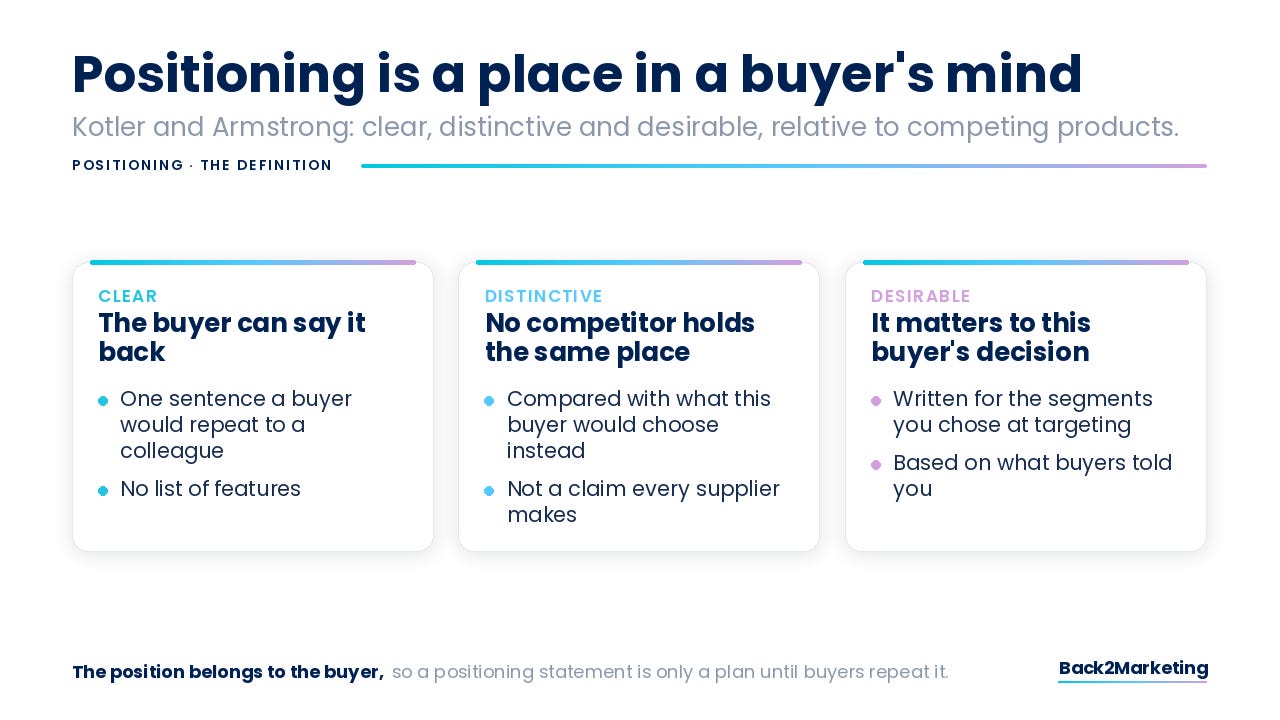
Kotler and Armstrong define positioning as arranging for a product to occupy a clear, distinctive and desirable place, relative to competing products, in the minds of target consumers.
In that definition, target consumers means a particular group of buyers, the segments the company chose at targeting. Relative to competing products means the position only exists in comparison with whatever those buyers would choose instead. Clear means a buyer can say it back to a colleague in one sentence. Distinctive means no competing supplier holds the same place. Desirable means the place matters to the decision that group of buyers is making.
Positioning comes after segmentation and targeting, because a position only exists in the minds of a chosen group of buyers. The essay on segmentation and targeting covered how to research a market and choose the segments to serve. Once those segments are chosen, the company still has to decide what it wants those buyers to think of it, and why.
Kotler and Armstrong put positioning inside the second step of the marketing process, designing a customer value-driven marketing strategy, and before the third step, the marketing mix. Positioning is a strategy decision. The product, price, channels and promotion are meant to carry the position once it’s chosen. They aren’t meant to choose it.
The position itself belongs to the buyer. A company can decide the place it wants to hold and work for years to earn it, but the place exists only in what buyers think. A positioning statement in a strategy document records the place the company is aiming for.
A positioning statement is a plan for the place you want to hold. The position is what buyers actually think of you.
Positioning starts with what the buyer would choose instead
Competing products, in the definition, means the options a buyer is weighing up. In B2B those are often not the suppliers a company lists on its competitor slide.
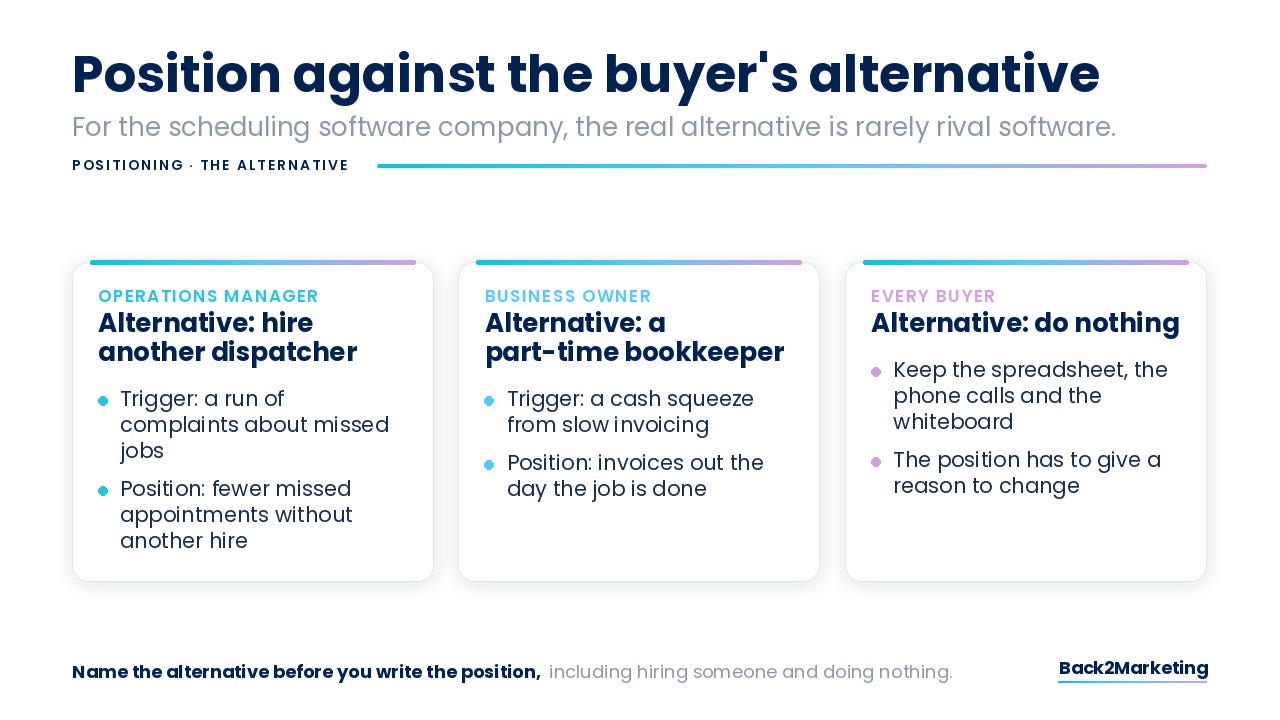
For example, take the scheduling software company from the segmentation essay and the In Practice articles. It sells to businesses that send staff out to customer sites. For the operations manager in a trades business, the real alternative isn’t another scheduling product. It’s hiring another dispatcher. For the owner of a small business that waits weeks to send invoices, the alternative is a part-time bookkeeper. If the company positions itself against rival software, it answers a question neither buyer is asking. If it positions itself against the dispatcher and the bookkeeper, it speaks to the decision each buyer is actually making.
The alternative also includes doing nothing. Many B2B purchases end with the buyer keeping the spreadsheet, the phone calls and the whiteboard. A position has to give the buyer a reason to change, not only a reason to prefer one supplier over another.
A typical B2B buying decision involves 13 internal stakeholders and nine external influencers, according to Forrester’s State of Business Buying 2026. Each of those people may have a different alternative in mind. The finance lead compares the cost with a bookkeeper’s salary. The operations manager compares it with the dispatcher. The position has to stay clear when it’s repeated by people who never saw the sales pitch.
Find out what the buyer would choose instead of you before you write a position.
Most B2B positioning tries to say everything
Nobody sets out to write a list. It grows one reasonable addition at a time. The product team adds the new feature from this quarter’s release. The sales team asks for a proof point for every objection they hear. The security team wants the certifications mentioned. Leadership doesn’t want to rule out any deal, so the message is written to suit every buyer in every segment. Each addition makes sense on its own. Nobody takes anything out.
What the company ends up with is a product description. It reads almost word for word like the competitors’ descriptions, because every supplier in the category is answering the same buyer questions with the same kinds of claims.
Only 14 per cent of B2B decision makers saw a real difference between suppliers and valued it enough to pay for it, according to a study of about 3,000 B2B purchasers across 36 brands by the CEB Marketing Leadership Council with Google and Motista. Most buyers saw suppliers as interchangeable, or saw a difference that didn’t matter to them.
64 per cent of B2B customers can’t tell the difference between one B2B brand’s digital experience and another’s, according to a Gartner survey of more than 1,100 B2B customers published in 2021. Gartner also found that seeing a difference between supplier offerings was one of three factors that raised customers’ confidence in a purchase.
When buyers see no meaningful difference, they don’t spend weeks looking for one. They choose the supplier they already know, the one a colleague recommended, or the cheapest.
When every supplier claims everything, buyers stop looking for a difference and choose the name they already know.
Buyers choose from the suppliers they think of when the problem comes up
Buyers don’t evaluate a market from scratch each time they buy. They think of a few suppliers when a need arises, and they compare those few.
Jenni Romaniuk at the Ehrenberg-Bass Institute calls the situations that prompt a purchase category entry points. Buyers retrieve brands from memory through those situations: a run of complaints about missed appointments, a cash squeeze, a failed audit. A brand linked in buyers’ minds to the situation that triggers the purchase is more likely to be thought of when that situation occurs. In her research with the LinkedIn B2B Institute, Romaniuk assesses each possible entry point on how credible the brand is in that situation, how many competitors are already linked to it, and how common the situation is.
A position tied to one buying situation gives buyers something to remember. A list of six claims gives them nothing to attach the brand to. Fast, secure and easy to use apply to every situation equally, so they don’t help a buyer think of you in any particular one.
A long list also makes the buyer’s decision harder. Customers who face conflicting high-quality information are 153 per cent more likely to settle for a smaller and less disruptive purchase than they planned, according to a Gartner survey of more than 1,000 B2B customers published in 2019. Adding more claims can shrink the deal a supplier is trying to win.
A position works when a buyer thinks of you at the moment the problem comes up.
Difference and distinctiveness do different jobs
Some marketers will object that buyers don’t need a difference at all. Jenni Romaniuk, Byron Sharp and Andrew Ehrenberg found low perceived differentiation across competing brands in many categories in two countries, and buyers bought those brands anyway. They argued that brand strategy should centre on distinctiveness, meaning the names, colours, logos and ways of speaking that make a brand easy to recognise, rather than on differentiation. The study covered consumer categories, not B2B, so treat it as a strong caution rather than a rule for B2B.
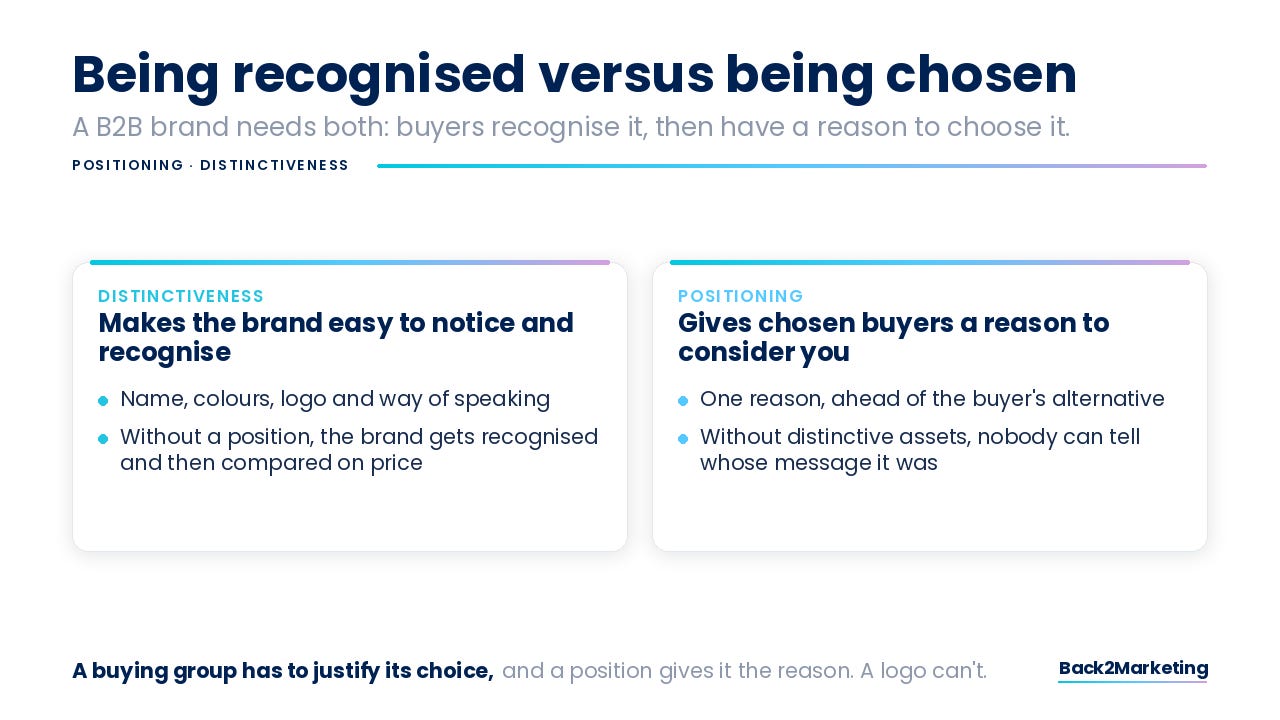
Positioning is still needed, because distinctiveness and positioning do different jobs. Distinctiveness makes a brand easy to notice and recognise. Positioning gives a particular group of buyers a reason to consider the brand ahead of their alternative. A distinctive brand with no position gets recognised and then compared on price. A clear position with no distinctive assets gets forgotten because nobody can tell whose message it was.
B2B buying has an extra reason to need a position. A buying group has to justify its choice to the people who approve it. The operations manager has to explain to the finance lead why the software beats hiring a dispatcher. A clear position gives the operations manager that explanation. A logo doesn’t.
Distinctiveness gets the brand noticed and remembered. Positioning gives the buyer a reason to choose it.
Positioning means choosing which claims to leave out
Strategy is making trade-offs in competing, and the essence of strategy is choosing what not to do. Michael Porter wrote that in Harvard Business Review in 1996. He gave inconsistency in image or reputation as one of the reasons trade-offs exist: a company known for one kind of value loses credibility when it tries to claim another at the same time.
Positioning is where marketing makes trade-offs about what the company stands for in the buyer’s mind. A position that claims to be the fastest, the cheapest, the most complete and the easiest to use has made no trade-off. Buyers don’t believe it, and competitors can copy every claim on it.
Take out claims written for buyers the company didn’t target, because the position isn’t for them. Take out claims every competitor can make equally, such as security, ease of use and good support, because they don’t separate you from anyone. Take out features that don’t support the reason you’ve chosen, however much the product team cares about them.
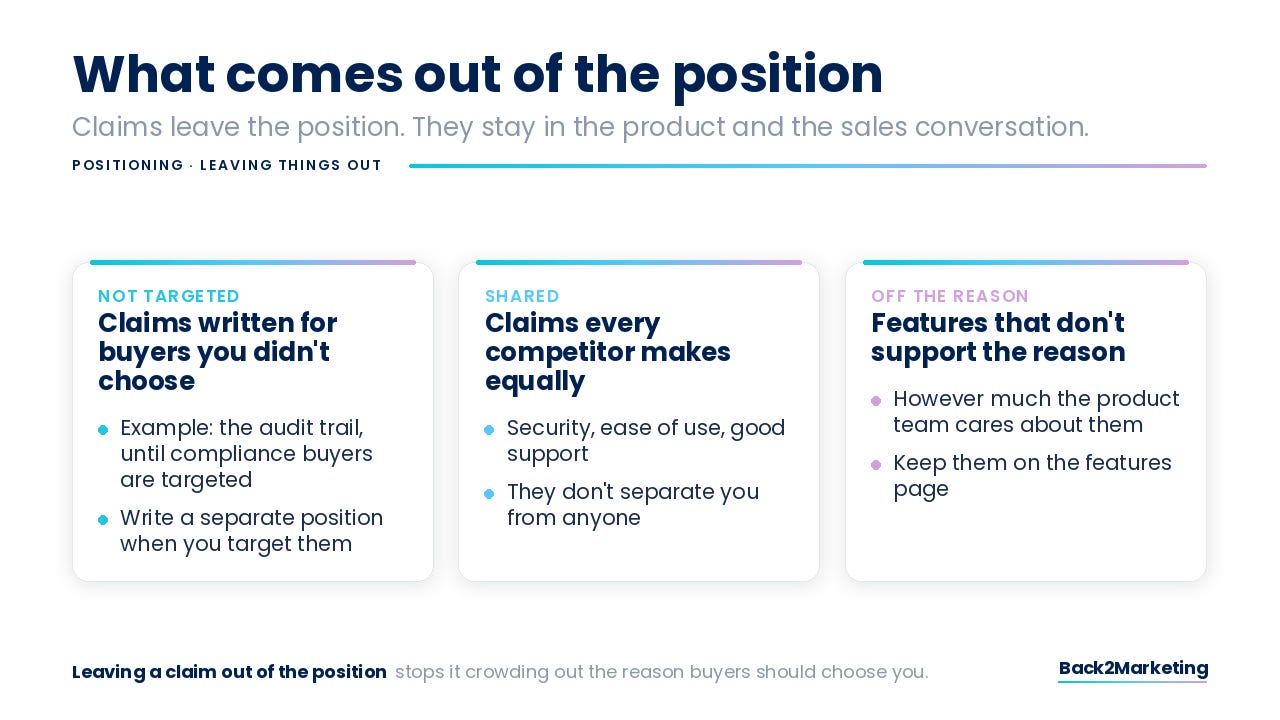
Leaving a claim out of the position doesn’t remove it from the product or from the sales conversation. Go back to the scheduling software company. Its product also keeps an audit trail of every site visit, and it connects to several accounting systems. For the operations manager, the company’s position is fewer missed appointments without hiring another dispatcher. The audit trail is still in the product. It’s on the features page and in the security pack, and a salesperson will mention it if a buyer asks. It isn’t in the position, because the company chose not to target compliance buyers until its compliance features ship next year. When it does target them, it will write a separate position for that segment.
Leaving claims out is uncomfortable because it feels like giving up deals. In practice the company gives up the buyers it wasn’t going to win, and gives the buyers it chose a clearer reason to pick it.
Leaving a claim out of the position doesn’t remove it from the product. It stops that claim crowding out the one reason buyers should choose you.
Positioning is decided once at strategy level, then repeated for years
In many companies positioning is never decided as a strategy choice. It gets written by default in each campaign brief. Each new campaign brings a new message, each product launch adds a new claim, and after a few years the company has used a dozen positions and holds none of them.
The business stakeholder supplies the commercial objective, the segments in scope and an accurate view of the competition. Marketing then makes the positioning decision as part of the marketing strategy, before anyone writes a campaign brief. Once the position is agreed, every campaign brief should carry it unchanged. The campaign team decides how to express the position for a particular audience and moment. The campaign team doesn’t decide what the position is.
A position is earned slowly. Buyers who aren’t in the market today need to meet the same idea many times before it becomes the thing they think of when the problem arises. Up to 95 per cent of business buyers aren’t in the market for a category at any one time, according to John Dawes at the Ehrenberg-Bass Institute. Treat the ratio as a rule of thumb rather than a constant. Most of the buyers a company will win next year aren’t paying attention this quarter, so a company that changes its position every quarter keeps starting again with the buyers who matter most.
The position also has to be repeated inside the company. The sales deck, the website, the product launch announcement and the conference stand all need to say the same thing. If the sales team doesn’t use the position, buyers hear something different from each team.
Decide the position once at strategy level, then repeat it in every campaign instead of rewriting it in each one.
Before you sign off a positioning, check it against these questions
Name the buyer it’s written for. If the answer is “our customers” or “the mid-market”, it’s written for nobody in particular, and the segmentation and targeting work has to come first.
Name what that buyer would choose instead. Include hiring someone, keeping the spreadsheet and doing nothing. If the only alternatives on the page are named competitors, ask recent buyers what they actually compared.
State the reason to choose you in one sentence a buyer would say to a colleague. If the sentence needs “and” more than once, it’s still a list.
Show the proof a buyer would accept. Proof can be a customer result, a demonstration or a guarantee. Without proof, the reason is only a claim.
Write down what you’ve left out, and get the sales team to agree. If the sales team will put the dropped claims back into the deck, the decision hasn’t been made yet.
If you can’t answer these, you have a product description, not a position. If you can, you have a position worth repeating for years.
Positioning is a decision, not a set of words
Positioning gets treated as wording: a tagline, a messaging house, a set of key messages for the campaign brief. Wording comes last. Positioning is the decision about which buyers you want to be chosen by, what they’d choose instead, and the one reason they should choose you. A company that makes the positioning decision can cut its message to one reason and repeat it until buyers remember it. A company that avoids it ends up saying everything, and buyers treat it like every other supplier.
Positioning doesn’t need new tools. It needs research into what buyers compare, a decision about the reason they should choose you, and the discipline to keep the other claims out of the position even when someone in the room wants them back in.
We believe marketing is a commercial discipline, not a promotional service.
We believe the decisions that matter most are made before anyone writes a brief, and that positioning is one of them.
We believe judgement is what turns evidence into a decision, and that choosing what to leave out is a judgement no dataset can make for you.
Positioning is why a buyer chooses you over the alternatives. It means deciding what to leave out.
Back2Marketing exists to help marketers make better decisions, by combining the best available evidence with commercial judgement and practical experience.
Evidence informs. Judgement decides.
New essays land here first: subscribe and the next one will find you.
And if you want to build the judgement, not just the output, Back2Marketing’s B2B Marketing Fundamentals course teaches marketing from first principles.
Sources
Philip Kotler and Gary Armstrong, Principles of Marketing. Definition of positioning; positioning placed in the second step of the marketing process, designing a customer value-driven marketing strategy, ahead of the marketing mix.
Forrester, The State of Business Buying, 2026, January 2026. A typical B2B buying decision involves 13 internal stakeholders and nine external influencers, more for larger purchases.
CEB Marketing Leadership Council with Google and Motista, From Promotion to Emotion, 2013. About 3,000 B2B purchasers, 36 brands. Only 14 per cent of business decision makers saw a real difference between suppliers and valued it enough to pay for it.
Gartner, press release, May 2021. More than 1,100 B2B customers surveyed in December 2020. 64 per cent cannot tell the difference between one B2B brand’s digital experience and another’s; perception of difference between supplier offerings is one of three statistically significant drivers of customer confidence.
Gartner, press release, July 2019. More than 1,000 B2B customers. Customers facing conflicting high-quality information are 153 per cent more likely to settle for a course of action smaller and less disruptive than planned.
Jenni Romaniuk, Ehrenberg-Bass Institute for Marketing Science with the LinkedIn B2B Institute, Category Entry Points in a B2B World, 2022. Buyers retrieve brands by buying situation; candidate entry points screened on credibility, competition and commonness.
Jenni Romaniuk, Byron Sharp and Andrew Ehrenberg, Evidence concerning the importance of perceived brand differentiation, Australasian Marketing Journal, 2007. Low perceived differentiation across competing brands in many categories and two countries; distinctiveness, not differentiation, proposed as the centre of brand strategy. Consumer categories, not B2B.
Michael E. Porter, What Is Strategy?, Harvard Business Review, November and December 1996. Strategy is making trade-offs in competing; the essence of strategy is choosing what not to do; inconsistency in image or reputation as one source of trade-offs.
John Dawes, Ehrenberg-Bass Institute for Marketing Science with the LinkedIn B2B Institute, Advertising Effectiveness and the 95-5 Rule: Most B2B Buyers are Not in the Market Right Now, May 2021. Up to 95 per cent of business buyers are not in the market for a given product or service at any one time. Treat the ratio as a rule of thumb.