


The sales team has sent you a spreadsheet of 400 company names. It’s called a Target Account List (TAL), and the campaign brief from the business stakeholder says the campaign is for the companies on that list. A TAL looks like a targeting decision, because it names the companies your advertising should reach. But it’s a list of the companies the sales team most wants to win. Nobody has decided which segments of the market your company will serve.
Only a few of those 400 companies are likely to be looking for a product like yours this quarter, so a campaign aimed only at the TAL often falls short of the lead target. Many marketing teams add “white space” to the media plan for that reason. White space means companies that aren’t on the TAL, usually bought as a broad group such as every company in one industry. Nobody chose those companies by segment either, so the same message goes to all of them and some leads come from companies your sales team can’t win.
The sales team has good reasons to build a TAL. A salesperson has a revenue target for the quarter, and a list of named companies is how they plan their time. Salespeople often list large, well-known companies, because one deal with a large company can be worth many deals with small companies.
Your company may already have an ideal customer profile (ICP). An ICP describes companies by industry and size. It doesn’t say which problem those companies want fixed, so you still need a targeting decision.
Choosing which segments to serve is called targeting, and a TAL should come after it. Kotler and Armstrong (2023) define market targeting as “evaluating each market segment’s attractiveness and selecting one or more segments to enter”. Account-based marketing (ABM), where sales and marketing concentrate on named accounts, comes after that decision too, because you choose the segments before you choose the accounts in them. With the targeting decision made, you know where to aim lead generation, where to aim brand advertising and which accounts the sales team should follow up. You write the result of each step on one worksheet, which is attached at the end of this guide.
1. Sort the Target Account List into your market segments
A market segment is a group of buyers who want the same problem fixed. If your company hasn’t divided its market into segments, do that first with the In Practice guide on market segmentation.
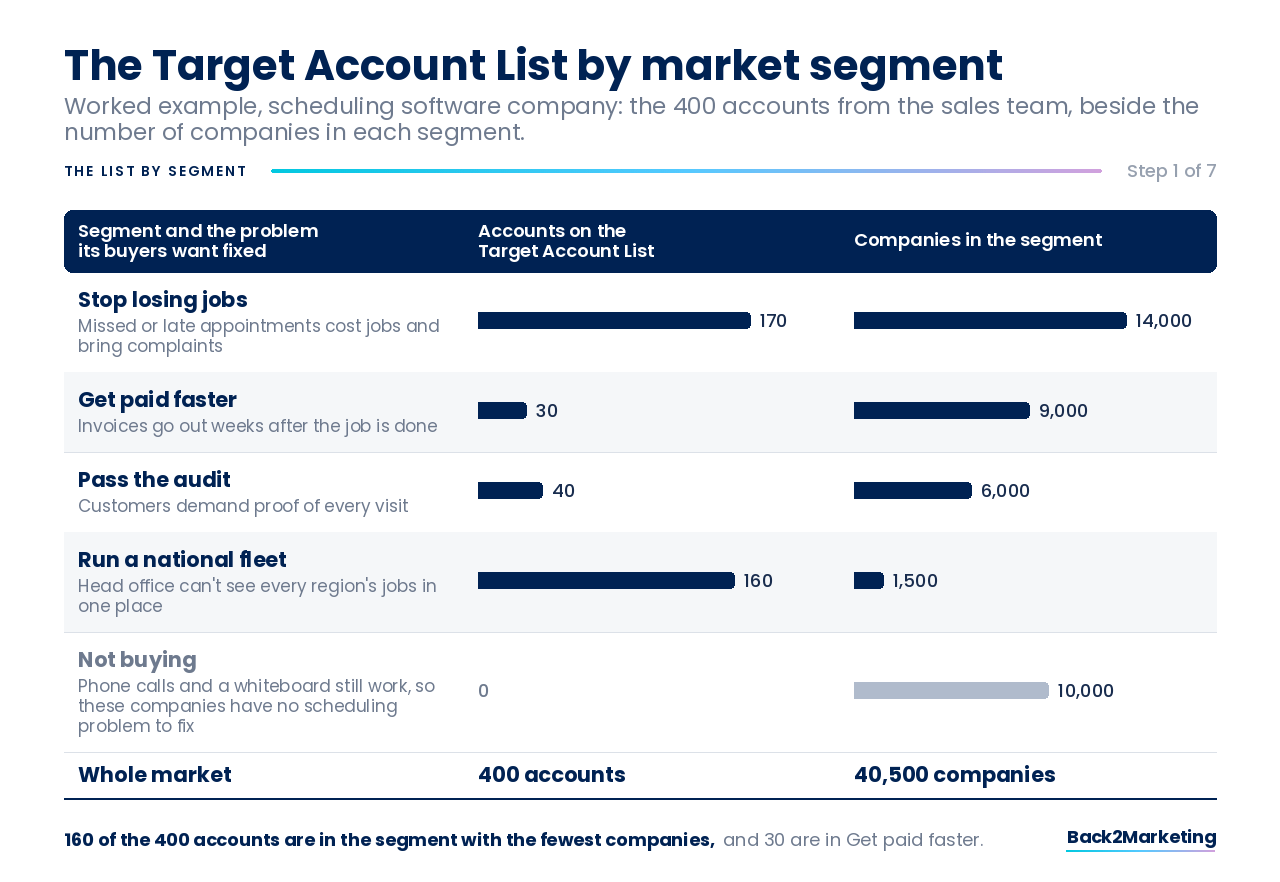
To help illustrate, take a company that sells scheduling software to companies that send employees out to customer sites. Its market is about 40,500 companies in Australia and New Zealand, and its sales team has sent the marketing team a TAL of 400 accounts for the next campaign. The marketing team has found these segments in that market:
Stop losing jobs. A missed or late appointment costs these companies a job and brings a complaint. About 14,000 companies are in this segment, and most are trades companies with 20 to 200 employees.
Get paid faster. About 9,000 companies send their invoices weeks after the job is done. Most of them are trades companies with fewer than 20 employees.
Pass the audit. Customers demand proof of every visit from about 6,000 companies, many of them in fire safety, medical equipment servicing and utilities contracting.
Run a national fleet. About 1,500 companies schedule jobs in several regions, and head office staff can’t see every region’s jobs in one place.
Another 10,000 companies have no scheduling problem to fix, and the marketing team lists them as Not buying.
Add each account’s industry and number of employees to the TAL from the customer relationship management (CRM) system. Sort the TAL by industry and company size first, using the industries and company sizes from your market segmentation. Sorting by industry and company size gives only a first estimate. Ask the salesperson named beside each account which problem the company has talked about, and move the account if it belongs in a different segment. When a company has 2 of the problems, use the problem that made it start looking for a product.
Count the accounts in each segment, and write each count beside the number of companies in that segment. The scheduling company’s TAL has 170 accounts in Stop losing jobs, 160 in Run a national fleet, 40 in Pass the audit and 30 in Get paid faster. Get paid faster has 9,000 companies, and 30 of them are on the TAL.
You now know where the sales team wants to sell. You don’t know yet know whether your company can win in those segments.
2. Compare the segments on size, competition and fit
Write down the same facts about every segment, so that the business stakeholder can compare one segment with another. Kotler and Armstrong (2023) say a company evaluating segments must look at segment size and growth, segment structural attractiveness, and company objectives and resources. You can think of them as size, competition and fit.
Size and growth. Copy the number of companies in the segment from your market segmentation. Ask the sales team what a customer pays in a year, or the price they quoted in lost deals. Multiply the number of companies by that price. The result is the most the segment could be worth in a year, because it assumes every company in the segment buys from you. If you haven’t counted the companies yet, use an estimate and label it as an estimate. Note whether the number of companies in the segment is growing.
Competition. Ask the sales team which competitors they meet in the segment. Copy from your market segmentation what the segment’s buyers would do instead of buying a product like yours. A segment is less attractive when strong competitors already sell to it or when buyers have an easy alternative.
Fit. Write whether your product fixes the segment’s problem today. Then take the last 50 deals, which you sorted into segments for your market segmentation, and count the deals won in each segment. If a segment has fewer than 5 deals, rely more on what your product can do today than on the count. Note what it costs to win and serve a customer in the segment, and whether customers in this segment later move into another segment you serve.
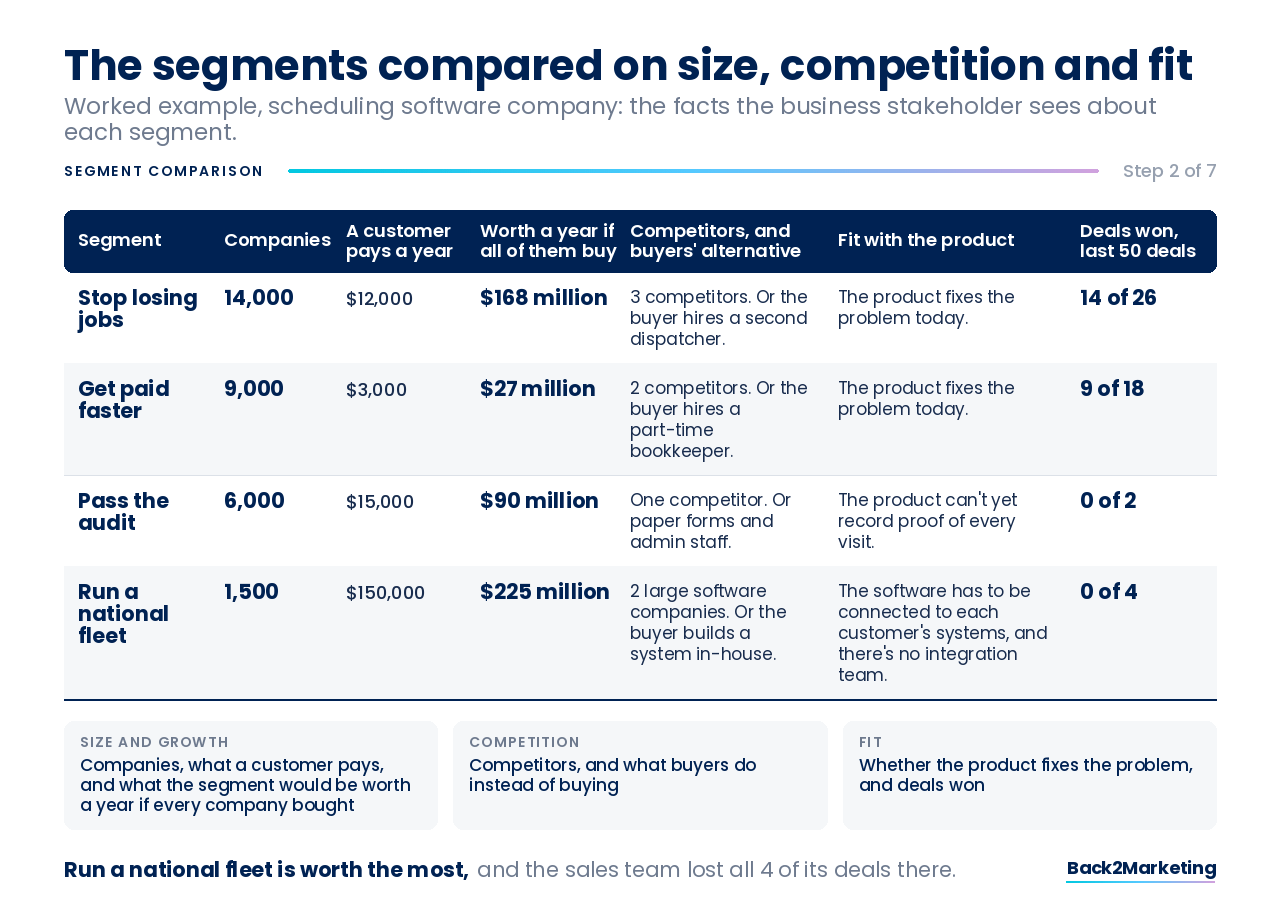
In the scheduling company’s comparison, a customer in Stop losing jobs pays about $12,000 a year, so the segment’s 14,000 companies would be worth about $168 million a year. The same calculation gives $27 million for Get paid faster at $3,000 a customer, $90 million for Pass the audit at $15,000 and $225 million for Run a national fleet at $150,000.
Run a national fleet has the largest customers, which is why 160 of its companies are on the TAL. The product doesn’t fit. The software has to be connected to each customer’s own systems, and the scheduling company has no integration team. The sales team competes against two large software companies in this segment, and it lost all 4 of its deals there.
Get paid faster is worth the least, and the product fits it. The product already sends the invoice when the job is marked done, and the sales team won 9 of its 18 deals. Many of these small companies will grow and start missing appointments, so a customer won here can become a customer in Stop losing jobs.
A customer in Pass the audit would pay about $15,000 a year, and the sales team meets one competitor there. The product can’t yet record proof of every visit, and the sales team lost both of its deals in the segment.
3. Choose the segments to serve with the business stakeholder
Show the comparison to the head of sales first, so that the sales team’s facts are right before the meeting. Then take it to the business stakeholder who wrote the campaign brief, with the head of sales in the meeting. For each segment, recommend a decision:
Serve now. Your product fixes the segment’s problem today, and the sales team wins deals there.
Serve later. The segment is attractive, and your company has a plan to get the product or the sales team ready for it.
Don’t serve. Your company can’t win there, and it has no plan to change that.
The business stakeholder makes the final choice. If the decision changes what the product team builds, the business stakeholder may need approval from the company’s leadership team.
Recommend only as many segments as your product, your sales team and your budget can serve well. A company that tries to serve every customer tends to serve all of them poorly.
A head of sales may argue for the segment with the largest customers. The argument is fair, because one of those customers can be worth many smaller customers. Go through the lost deals together, and write down what your company would have to build to win in that segment. Ask the business stakeholder whether the company will fund that work. If it will, the decision is Serve later, and if it won’t, the decision is Don’t serve.
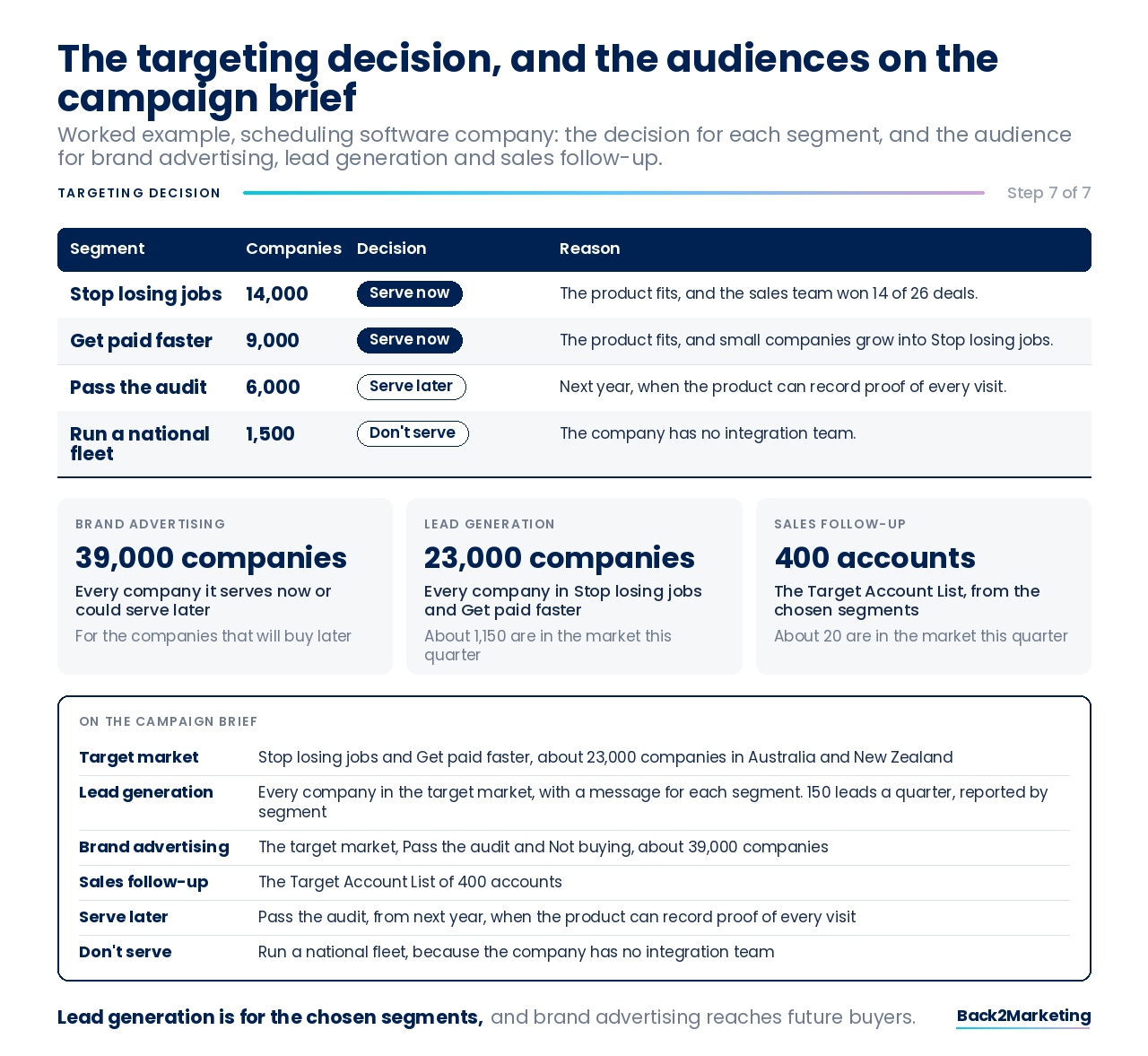
The scheduling company chooses Stop losing jobs, where the sales team won 14 of its 26 deals, and Get paid faster. Together those segments have about 23,000 companies. The company will serve Pass the audit next year, when the product team plans to add proof of every visit. It won’t serve Run a national fleet, because it has no integration team and no plan to hire one.
Write the reason beside every segment you aren’t serving now, because people who weren’t in the meeting will ask why.
4. Aim lead generation at the chosen segments, and report leads by segment
Many B2B marketing teams are measured on the number of leads they pass to the sales team. You’re still measured on leads after the targeting decision is made. What changes is which companies the leads come from.
A lead can become a deal this quarter only if the company is in the market. That means the company is looking for a supplier now. About 5 per cent of business buyers are in the market in any quarter, on John Dawes’s estimate at the Ehrenberg-Bass Institute. Dawes bases the estimate on corporations changing a service provider, such as a bank or a law firm, about once every 5 years. The share in your market depends on how often your buyers change suppliers.
The scheduling company’s marketing team has a lead target of 150 leads a quarter. At 5 per cent, about 20 of the 400 accounts on its TAL are in the market in a quarter. More than 20 are in the market when the sales team chose accounts that had already enquired, and one company can send more than one lead. About 1,150 of the 23,000 companies in the chosen segments are in the market. Aim lead generation at every company in the chosen segments, because far more of them are in the market than the accounts on a TAL.
Don’t aim lead generation at the whole market either. A lead from a segment your product doesn’t fit usually becomes a deal the sales team loses. The scheduling company lost all 6 of its deals in the segments it isn’t serving now.
Replace white space in the media plan with the chosen segments. In the media brief, give each segment’s industries, its company sizes and the job titles of the people who make and influence the buying decision. You can’t select companies in an advertising platform by the problem they want fixed, and those industries and company sizes include companies outside the segment. So write a separate message for each chosen segment that names its problem.
Use paid search on each segment’s problem to reach the companies that are ready to buy now. If the CRM shows which companies have talked about a segment’s problem, add those companies to the media brief.
Add one question to your lead form. List every segment’s problem in the buyers’ words, such as “We miss appointments or arrive late”, and add “A different problem”. Ask the person filling in the form to choose the problem their company most wants fixed. From the answer, you know the lead’s segment, and the salesperson knows what to talk about in the first call. After a quarter, check which industries and company sizes each segment’s leads came from, and update the media brief.
Report leads by segment each month, show the leads from accounts on the TAL as a separate number, and add the deals won in each segment when the sales team closes them. If many leads come from a segment you aren’t serving now, show the count to the business stakeholder as a sign of demand.
5. Aim brand advertising at every company you can serve, now or later
Brand advertising is for the companies that will buy later, and in any quarter that’s most of the market. Dawes argues that advertising works mainly by building a memory of the brand in buyers’ minds, and buyers use that memory when they do come into the market.
Brand building and lead generation need different audiences. Les Binet and Peter Field studied B2B campaigns, and they write that sales activation, which includes lead generation, should be tightly targeted on buyers who are ready to respond. Brand building, they add, needs much broader reach and has to reach people before they come to market. On the condition that B2B markets follow the same rules as consumer markets, they advise reaching as many buyers of the category as you can with brand advertising. Binet and Field had fewer than 50 B2B cases, and they call their findings tentative.
Lead generation, the product and the sales follow-up each have to fit a particular segment’s problem, so they follow the targeting decision. Brand advertising is about your company, and the same advertising can go to several segments.
Aim brand advertising at every company you serve now or could serve later, as far as the budget allows. A company you could serve later is in your market definition and in a segment you haven’t decided against. Leave out any company that will never need a product like yours.
Use one message about what your company does. If the budget can’t reach all of those companies, reach the chosen segments first. Inside each company, reach the buying committee and the people who influence it, such as the people who use the product.
For the scheduling company, that audience is about 39,000 of the 40,500 companies in its market. It includes the 6,000 companies in Pass the audit, which will already know the scheduling company when the product is ready next year. It also includes the 10,000 companies in Not buying.
The companies in Not buying send employees out to customer sites, so they could buy scheduling software, and some of them will have a scheduling problem as they grow. The scheduling company leaves out only the 1,500 companies in Run a national fleet, because it has decided not to sell to them. Leaving out Run a national fleet is the company’s own judgement, and Binet and Field’s advice doesn’t exclude any buyer of the category.
If your whole budget is for lead generation, show Binet and Field’s findings to the business stakeholder and ask for a brand advertising budget. About 46 per cent of the budget on brand building and 54 per cent on sales activation appeared to be the most efficient split in their B2B cases. They call the ratio a rough estimate.
6. Use the Target Account List for sales follow-up
Keep the TAL, and use it to decide which companies a salesperson contacts first. Leads from other companies in the chosen segments go to the sales team as they do today.
Go through the list with the head of sales, who decides which accounts stay. Accounts in the chosen segments stay. An account outside the chosen segments stays when the head of sales has a commercial reason, such as an open deal or an existing customer, and the campaign budget isn’t spent on it. Each salesperson replaces their other accounts with the same number of accounts from the chosen segments, starting with companies that have already responded to your marketing.
On the scheduling company’s TAL, the 200 accounts in Stop losing jobs and Get paid faster stay. Its 8 salespeople can each follow up 50 accounts, so they replace the other 200 accounts and the TAL stays at 400. None of the other 200 accounts has an open deal or is an existing customer.Only a few of the 400 accounts on a sales list are looking to buy this quarter.a The 40 accounts in Pass the audit can come back when the product is ready.
Salespeople who give up their largest accounts will ask how they can still meet their revenue targets, so the business stakeholder and the head of sales need to agree an answer before the accounts change.
When someone at an account on the TAL becomes a lead, tell the salesperson named beside the account on the same day.
7. Write the target market on the campaign brief
Kotler and Armstrong (2023)define a target market as “a set of buyers who share common needs or characteristics that a company decides to serve”. On the campaign brief, write the target market where the TAL was, and add the audiences for lead generation, brand advertising and sales follow-up. The scheduling company’s campaign brief now says:
Target market. Companies in Stop losing jobs and Get paid faster, which is about 23,000 companies in Australia and New Zealand.
Lead generation. Every company in the target market, with a message for each segment. The lead target is 150 leads a quarter, reported by segment.
Brand advertising. The target market, Pass the audit and Not buying, which is about 39,000 companies.
Sales follow-up. The new TAL of 400 accounts.
Serve later. Pass the audit, from next year, when the product can record proof of every visit.
Don’t serve. Run a national fleet, because the company has no integration team.
Ask the business stakeholder to approve the new campaign brief before you brief the media team.
Use AI to sort the list, and check its work
Check your company’s policy before you put a list of sales accounts into an AI tool. Then give an AI assistant your TAL with each account’s industry and number of employees, and tell it the industries and company sizes for each segment. Ask it to suggest a segment for each account, to give its reason, and to mark the accounts where industry and number of employees aren’t enough to tell. Ask the salesperson named beside each account to confirm the segment.
Don’t ask the AI assistant to choose the segments, because the business stakeholder makes that decision.
Next steps
Count the accounts on your TAL in each market segment.
Compare the segments, and agree a decision for each one with the business stakeholder and the head of sales.
Aim lead generation at the chosen segments, and brand advertising at every company you can serve.
Review the TAL with the head of sales.
Write the target market on the campaign brief.
You can start even if the campaign brief isn’t yours. Sort the TAL by industry and company size this week, and count the accounts in each segment. Show your manager each count beside the number of companies in that segment.
Evidence informs. Judgement decides.
The Targeting Build
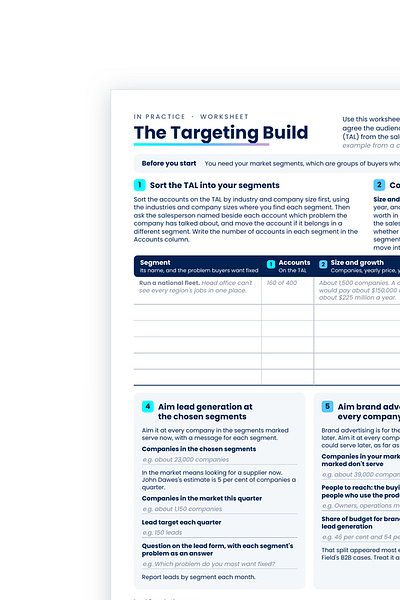
The Targeting Build is the one-page worksheet used in this guide. On the worksheet you count the accounts on your TAL in each segment, compare the segments and write a decision for each segment. Then you write the audiences for lead generation, brand advertising and sales follow-up. A worked example is printed on it, so you can fill it in without this guide open.
The In Practice guide on market segmentation shows how to divide your market into segments. The In Practice guide on positioning publishes on Monday 2 November.
New essays land here first. Subscribe to get the next one by email.
And if you want to build the judgement, not just the output, Back2Marketing’s B2B Marketing Fundamentals course teaches marketing from first principles.
Sources
Philip Kotler, Gary Armstrong and Sridhar Balasubramanian, Principles of Marketing, 19th edition (Global Edition), Pearson, 2023. Used for the definitions of market targeting and target market, and for the three factors for evaluating market segments: segment size and growth, segment structural attractiveness, and company objectives and resources.
John Dawes, Advertising Effectiveness and the 95-5 Rule: Most B2B Buyers Are Not in the Market Right Now, Ehrenberg-Bass Institute for Marketing Science and the LinkedIn B2B Institute, 2021. Used for the estimate that about 5 per cent of business buyers are in the market in a quarter and about 20 per cent in a year. Dawes bases this on companies changing a service provider, such as a bank or law firm, about once every five years. Also used for the finding that advertising works mainly by building a memory of the brand, which buyers use when they come into the market.
Les Binet and Peter Field, The 5 Principles of Growth in B2B Marketing: Empirical Observations on B2B Effectiveness, LinkedIn B2B Institute, 2019. Used for the advice that lead generation should target buyers who are ready to respond, while brand building needs broad reach before buyers come to market. Also used for reaching the buying committee and the people who influence it, such as the people who use the product, and for the budget split of about 46 per cent on brand building and 54 per cent on sales activation, which the authors call a rough estimate. The findings draw on fewer than 50 B2B cases in the IPA Databank, and the authors call them tentative.