



The target segment on the campaign brief is SMB New Logos. SMB is short for small and medium-sized business, and new logos are companies that haven’t bought from you before. SMB New Logos looks like a segment, but it only tells you that the companies are small or medium-sized and that they aren’t customers yet. It doesn’t tell you what the buyers in those companies want.
You then have to write one message for every small and medium-sized company that isn’t a customer yet. A 20-person accounting practice and a 300-person freight company both qualify. They buy for different reasons, through different people, on different budgets. A message written for both is too general to persuade either, so part of the media budget is spent on buyers the message doesn’t fit. You also can’t say how many of those companies want the product you’re advertising.
The business stakeholder had a sensible reason to write SMB New Logos. Sales territories are divided by company size, and the revenue plan separates new customers from existing customers, so the business already reports its revenue under names like SMB New Logos.
A segment is a group of buyers who want the same problem fixed. Dividing a market into segments is called market segmentation, and nobody did it before the business stakeholder wrote this campaign brief. With a market segmentation, you know which segments are in the market, what problem each segment’s buyers want fixed and how many companies are in each segment. You can draft a segmentation with 12 interviews and your sales team’s last 50 deals, and you can run a survey later to count the companies in each segment. You write the result of each step on one worksheet, which is attached at the end of this guide.
1. Define the whole market before you divide it
Write a market definition: one sentence that says which companies could buy this kind of product. Kotler and Armstrong define market segmentation as dividing a market into smaller groups of buyers with distinct needs, characteristics or behaviours who might require separate products or marketing mixes. The market you divide is every company that could buy: your customers, your competitors’ customers and the companies that haven’t bought from anyone.
To help illustrate, take a software company that sells scheduling software to companies that send employees out to customer sites: trades, equipment servicing, home care and facilities maintenance. The campaign brief from the business stakeholder says SMB New Logos, 10 to 500 employees, Australia and New Zealand. The scheduling company has 900 customers, and most of them are plumbing and electrical contractors.
The marketing team defines the market as every company in Australia and New Zealand that sends employees out to customer sites. The size limit of 10 to 500 employees from the campaign brief is left out, because a company with 5 employees or 800 employees could also buy scheduling software.
Next, work out the market size, which here means the number of companies that match your market definition. Use free public data. The Australian Bureau of Statistics (ABS) publishes counts of businesses by industry, and Stats NZ publishes the same for New Zealand. List the industries whose companies match your market definition, then add up the number of businesses in each industry. Where only some companies in an industry match, estimate the share. For the scheduling company, the market size is about 40,500 companies.
2. Interview customers, competitors’ customers and companies that bought nothing
Start with 12 interviews: 4 with customers, 4 with competitors’ customers and 4 with companies that bought nothing. The number 12 comes from research on interviewing. In a 2006 study of 60 in-depth interviews, almost all the topics the researchers recorded had come up by interview 12. Most of the common topics had come up by interview 6. The authors, Greg Guest, Arwen Bunce and Laura Johnson, interviewed a group of similar people for a health study. They warn that 12 probably won’t be enough when the people interviewed differ from each other.
Your buyers do differ from each other. Some chose you, some chose a competitor and some bought nothing. Use the first 12 interviews to draft the segmentation, then interview about 12 of each kind of buyer to finish it. If you sell several products or sell in several countries, your buyers vary more, so you need more interviews. In this example, the marketing team starts with 12 interviews and later completes 36 in total.
To find competitors’ customers and companies that bought nothing, ask the sales team for a list of the deals lost in the last 12 months. The list shows which companies chose a competitor and which companies looked at your product and bought nothing. For companies that have never contacted you, use the member list of a trade association.
Interview the person who makes the buying decision. The scheduling company interviews owners and operations managers. Tell the buyer that the interview takes 20 minutes and that you aren’t selling anything. Ask someone outside the sales team to run the interview, so that the buyer doesn’t expect a sales pitch. Some companies will say no, so contact more companies than you need.
3. Ask every buyer the same questions
Ask about the task your product does and how the buyer decided, and leave your product out of the questions. Asking every buyer the same questions lets you compare the answers. The scheduling company asks about scheduling. In your own questions, replace the word scheduling with the task your buyers use your product for, such as payroll or invoicing.
How do you handle scheduling today, and what goes wrong?
What made you look for something better, or what would make you look?
What happens if you change nothing?
What are you measured on in your job?
Who else has a say in a decision like this?
What else did you consider, or would you consider, instead of buying software?
Write one page of notes for each interview, in the buyer’s own words. Record the interview if the buyer agrees.
An operations manager at an electrical contractor tells the scheduling company’s interviewer that the contractor missed 3 appointments in one month and lost a contract. Instead of buying software, the operations manager would have hired a second dispatcher. The owner of another electrical contractor of the same size describes a different problem: jobs finished on a Tuesday were invoiced 3 weeks later. Instead of buying software, the owner would have hired a part-time bookkeeper.
4. Sort buyers by the problem they wanted fixed
The 2 electrical contractors are in the same industry and are the same size, and their buyers wanted different problems fixed. A 200-person home care provider is in a different industry and is a different size. Its buyer described the same problem as the operations manager at the electrical contractor: missed appointments. Sort by the problem that made each buyer start looking, because industry and company size would put these companies in the wrong groups.
When a buyer names 2 problems, use the problem the buyer gave as the reason for starting to look. When 2 or more buyers name the same problem, you have a draft segment.
Then test your draft segments against Kotler and Armstrong’s definition, which says the buyers in a segment might require separate products or marketing mixes. If 2 draft segments would buy the same product, for the same reason, in response to the same message, merge them into one segment.
Name each segment after what its buyers want, using the buyers’ words, and give it a row on the worksheet. In that row, write the problem, what the buyer would do instead of buying, and the job title of the person who makes the buying decision. After 12 interviews, the scheduling company has these draft segments:
Stop losing jobs. A missed or late appointment costs the company a job and brings a complaint.
Get paid faster. Invoices go out weeks after the job is done.
Pass the audit. The company’s own customers demand proof of every visit.
Run a national fleet. Each region schedules in its own way, and head office staff can’t see every region’s jobs in one place.
Some companies have no problem to fix, because phone calls and a whiteboard still work for them. Put those companies in a last row called Not buying, separate from the segments, so that the companies on the worksheet add up to the market size. A company that looked at products and bought nothing still had a problem, so it belongs in a segment.
Small and medium-sized companies that haven’t bought from you are in every row. The business stakeholder wrote them down as one segment.
5. Work out how many companies are in each segment
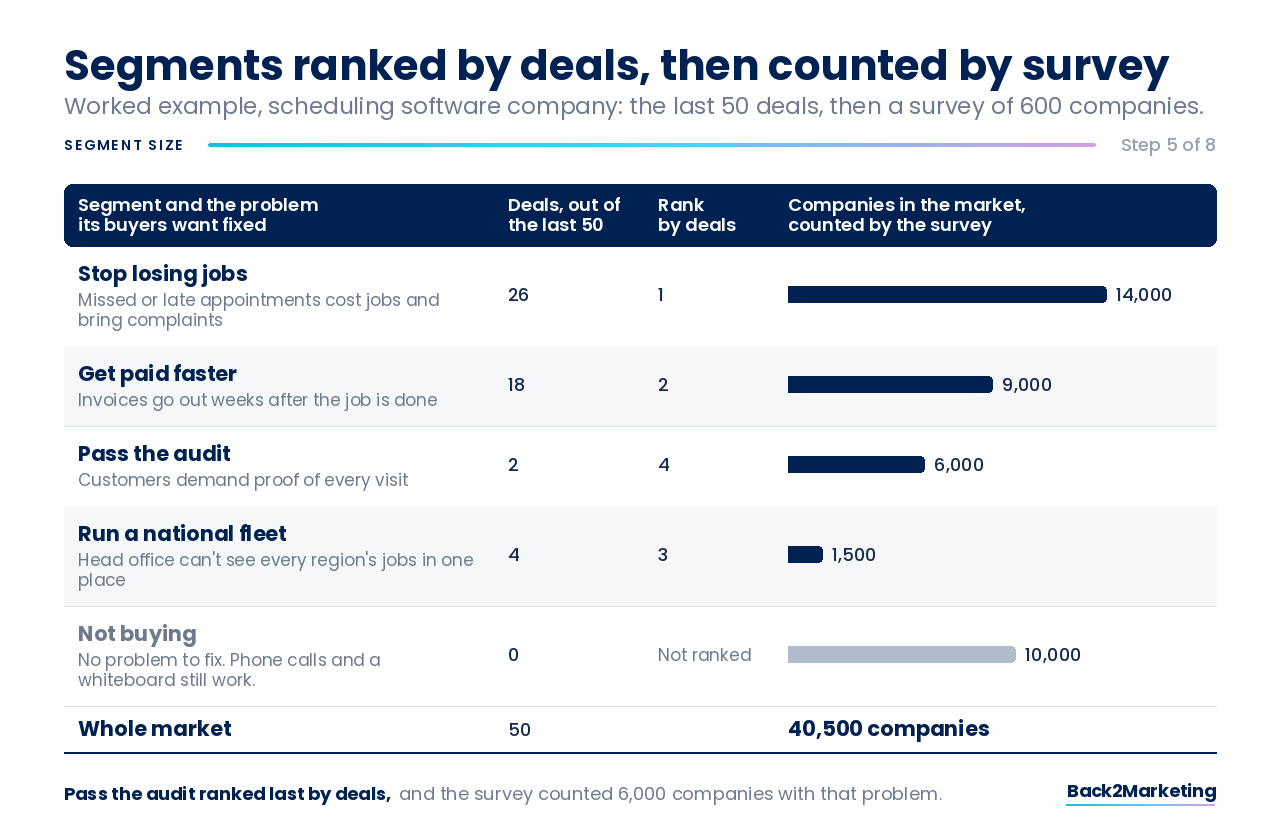
A survey is the only way to count the companies in each segment. Until you have a survey budget, rank the segments by number of deals, which you can do this week with data you already have. Go through the last 50 deals, won and lost, with the sales team, and put each deal in a segment. Salespeople often don’t record in the customer relationship management (CRM) system why the company was looking, so ask the salesperson who handled each deal. Then count the deals in each segment and rank the segments from most deals to fewest.
The scheduling company counts 26 deals in Stop losing jobs, 18 in Get paid faster, 4 in Run a national fleet and 2 in Pass the audit. No deals are in Not buying, because a company with no problem to fix doesn’t contact a sales team. Leave Not buying unranked.
Your sales team mostly deals with buyers who already found your company, so you can’t use the ranking to count the companies in each segment. Show the ranking to the business stakeholder as an estimate of which segments are larger, and explain that you need a survey to find out how many companies are in each segment.
When you have the budget, run the survey with a sample of companies from the whole market. A research agency can find the companies for you. Ask one question that lists each segment’s problem in the buyers’ words, and ask each company to choose the problem that would make it look for a product like yours. Add 2 more answers, “a different problem” and “no problem”. If many companies choose “a different problem”, interview some of them, because you may have missed a segment. Ask for the company’s industry, its number of employees and the job title of the person answering.
The scheduling company surveys 600 companies, and 35 per cent of them choose the missed appointments problem. The marketing team multiplies the market size of 40,500 by that percentage and estimates about 14,000 companies in Stop losing jobs. Very few companies choose “a different problem”, so the marketing team keeps the 4 segments.
After the survey, the order is different. Pass the audit had 2 of the 50 deals and ranked last. The marketing team now estimates about 6,000 companies in it, so it is the third-largest segment. It had only 2 deals because the sales team had rarely sold to fire safety, medical equipment servicing and utilities contracting companies, where customers ask for proof of every visit.
6. Add industry and company size to each segment
Industry and company size are called firmographics. Add them to the worksheet now. The media team and the sales team need the industry, the company size and the job title to reach the buyers in each segment.
For a draft segmentation, take the industries and company sizes from your interviews and the 50 deals. After the survey, check which industries and company sizes appear more often among the companies in a segment than among all the companies surveyed, and write them down. For the scheduling company, trades companies with 20 to 200 employees appear more often in Stop losing jobs.
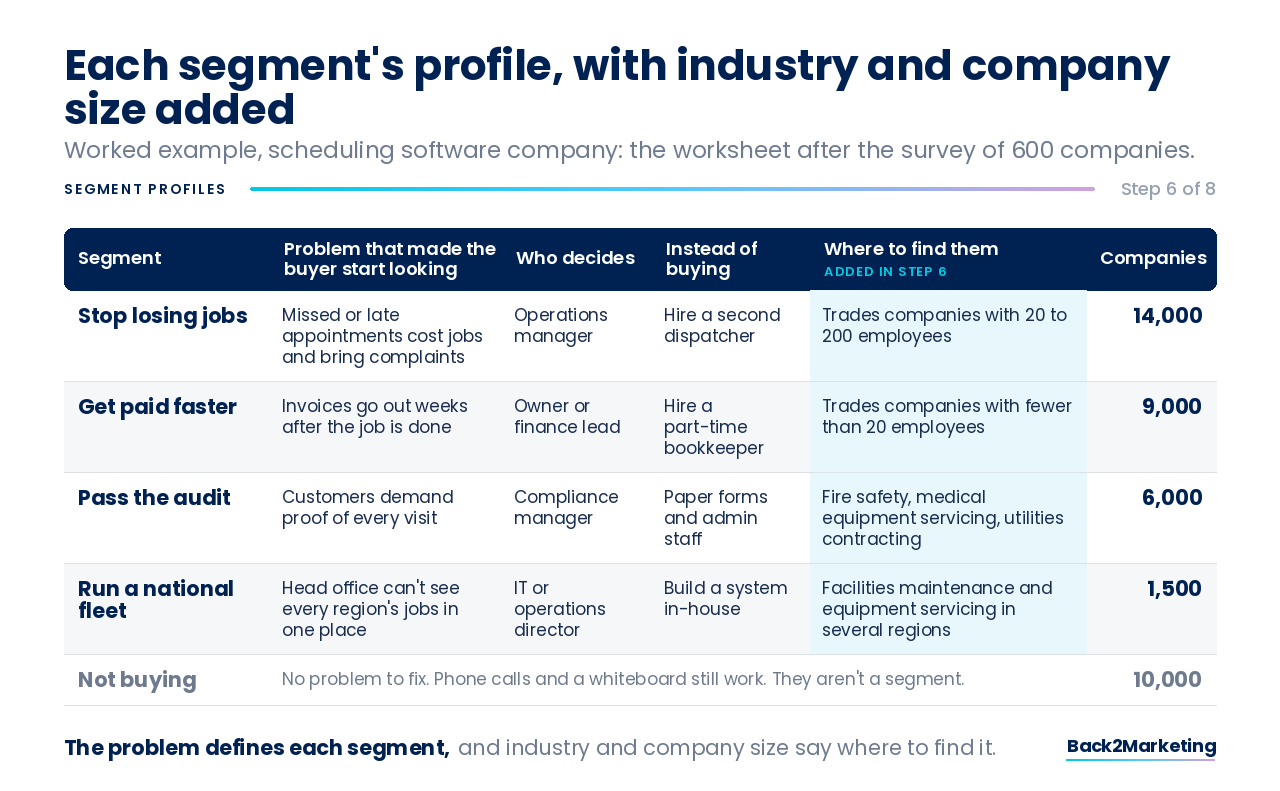
The problem buyers want fixed defines the segment, and firmographics tell you where to find it.
7. Test the segmentation before anyone uses it
Kotler and Armstrong set out requirements for effective segmentation. Turn each requirement into a check on your worksheet.
Measurable. You have counted the companies in every segment. If you only have a ranking, write “not yet counted” and ask the business stakeholder for a survey budget. Keep using the draft segmentation in the meantime.
Accessible. You can say where to reach each segment: which industries, which company sizes and which job title.
Substantial. Each segment has enough companies to be worth its own campaign.
Differentiable. You can place every company in one segment by the problem that made its buyer start looking, and no 2 segments would respond to the same message.
Actionable. You can describe the product, the message and the sales approach each segment would need.
Then check whether the buyers in each segment are customers, competitors’ customers or companies that bought nothing. If every buyer in a segment is your own customer, you don’t yet know whether competitors’ customers have the same problem. Interview more competitors’ customers before you use the segment.
When a segment fails a check, go back to the interviews. Merge the segment with another segment, split it, or interview more buyers.
8. Keep every segment on the worksheet, including the ones you won’t serve
The scheduling company can’t yet serve companies that schedule across several regions. The marketing team is tempted to delete Run a national fleet. If the marketing team deletes the segment now, the business stakeholder never gets to decide whether to serve those 1,500 companies. Keep Not buying on the worksheet as well, because some of those companies will later have a scheduling problem and move into a segment.
Choosing which segments to serve is called targeting. Kotler and Armstrong define market targeting as evaluating each market segment’s attractiveness and selecting one or more segments to enter. The business stakeholder makes that decision with the marketing team after the segmentation is finished.
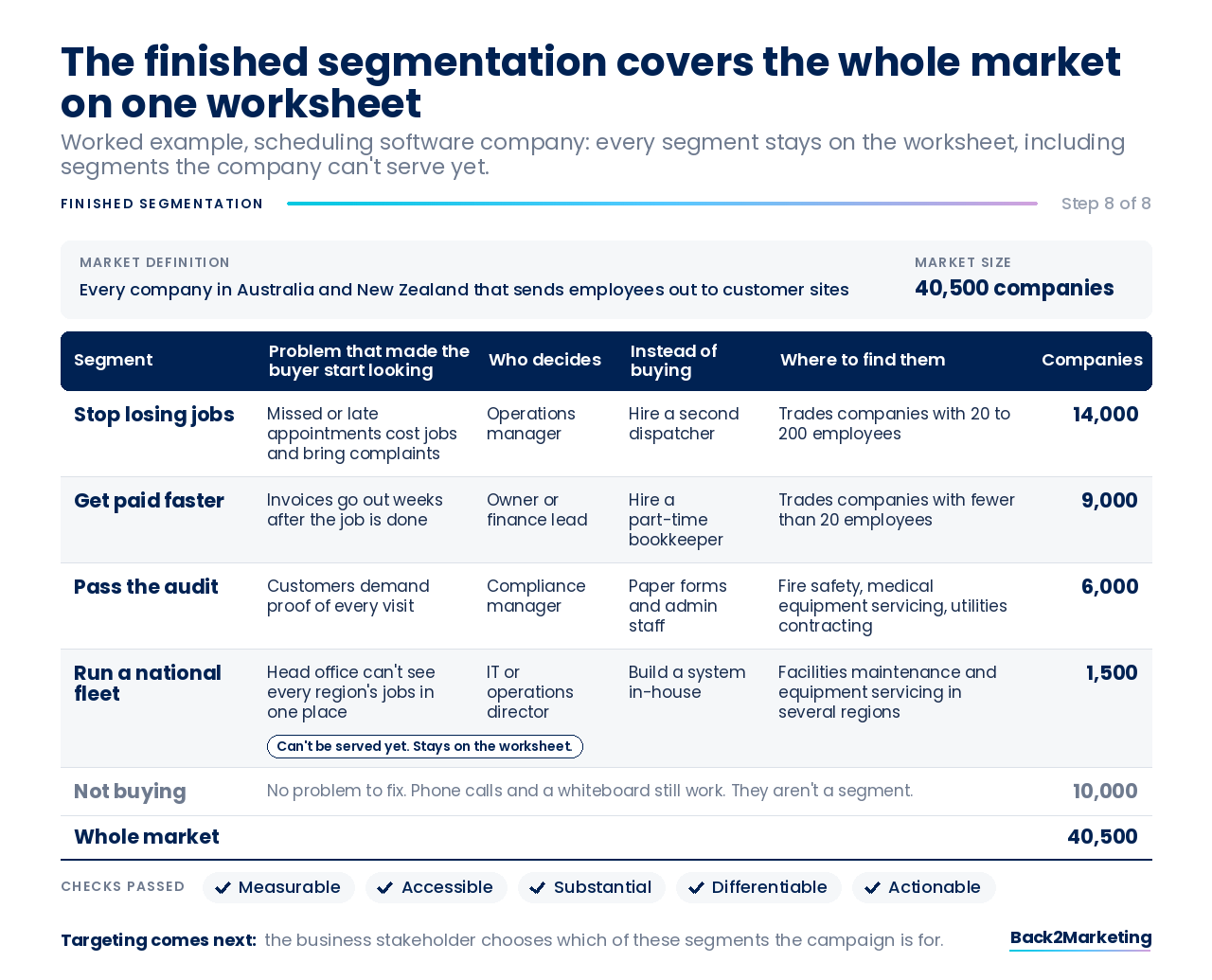
Take the worksheet to the business stakeholder who wrote SMB New Logos on the campaign brief. The business stakeholder can now see what the buyers in each segment want and how many companies are in each segment. Then the business stakeholder chooses the segments for the campaign and writes them on the campaign brief.
Use AI for the slow parts, and check its work
Record each interview if the buyer agrees, and tell the buyer you’ll use an AI tool to transcribe it. With a transcript, you have the buyer’s exact words. Ask an AI assistant to pull the buyer’s answers out of each transcript and list them under the 6 interview questions. Then ask it to group the buyers by the problem that made each buyer start looking. It can also write each segment’s problem as an answer for the survey question.
Check its work against the transcripts. For each buyer, confirm that the problem the AI assistant chose is the problem the buyer said made them start looking, and that every quote appears in the transcript. Check your company’s policy before you put customer conversations into an AI tool.
Next steps
Find the target segment on your next campaign brief, and ask the business stakeholder what problem those buyers want fixed.
Write the market definition and work out the market size from public data.
Ask the sales team for the deals lost in the last 12 months and book 12 interviews.
Sort the interviews by problem, and rank the draft segments using the last 50 deals.
Add industry and company size, run the checks, and ask for a survey budget.
Take the worksheet to the business stakeholder who wrote the campaign brief.
You can start even if you’re a junior marketer and the campaign brief isn’t yours. Book 3 of the 12 interviews this week, with companies that chose a competitor. If the 3 buyers describe different problems, show your manager the interview notes and ask for time to do the other 9 interviews.
Evidence informs. Judgement decides.
The Segmentation Build
The Segmentation Build is the one-page worksheet used in this guide. On the worksheet you write the market definition and the market size, fill in one row for each segment and run the checks. The interview questions and a worked example are printed on it, so you can fill it in without this guide open.
The argument for why segmentation comes before targeting is in the essay Segmentation Is How You Understand a Market. Targeting Is How You Choose. The In Practice guide on targeting will be published after this guide.
New essays land here first: subscribe and the next one will find you.
And if you want to build the judgement, not just the output, Back2Marketing’s B2B Marketing Fundamentals course teaches marketing from first principles.
Sources
Philip Kotler and Gary Armstrong, Principles of Marketing. Definitions of market segmentation and market targeting, and the requirements for effective segmentation (measurable, accessible, substantial, differentiable and actionable).
Greg Guest, Arwen Bunce and Laura Johnson, How Many Interviews Are Enough? An Experiment with Data Saturation and Variability, Field Methods, vol. 18, no. 1, February 2006. 60 in-depth interviews with women in 2 West African countries, from a health research study. Saturation occurred within the first 12 interviews. After 12 interviews the authors had created 92 per cent of the codes developed for the first 30 transcripts, and 94 per cent of the high-prevalence codes had been identified within the first 6. The authors caution that 12 interviews will likely not be enough if the group is relatively heterogeneous. Primary source
Australian Bureau of Statistics, Counts of Australian Businesses, including Entries and Exits, July 2022 to June 2026, released 18 August 2026. Free counts of actively trading businesses by industry and by employment size range. Primary source
Stats NZ, New Zealand Business Demography Statistics, at February 2025, released 30 October 2025. Counts of enterprises by industry and by employee count.