


The key messages on the campaign brief are six bullet points. The product is fast to set up, easy for technicians to use, secure, scalable and connected to accounting software, and it now has AI scheduling. Three claims came from the product team and two from the sales team, and the business stakeholder added the AI line last week. Every claim is true. So are most of the claims on competitors’ home pages.
Only 14 per cent of B2B decision makers saw a real difference between suppliers and valued it enough to pay for it. The CEB Marketing Leadership Council found that in a study of about 3,000 B2B purchasers with Google and Motista. When buyers can’t see a difference that matters to them, they fall back on other ways to choose, such as the supplier they already know, a colleague’s recommendation or the lowest price. Your company spends its campaign budget saying what competitors already say.
Positioning is the choice of one reason a particular group of buyers should choose you over what they’d do instead. Kotler and Armstrong define positioning as arranging for a product to occupy a clear, distinctive and desirable place, relative to competing products, in the minds of target consumers. You choose that reason, prove it and put it in place of the list.
The six claims got onto the brief for good reasons. Each claim answers a question buyers have asked the sales team, and nobody wants to lose a deal because a claim was missing. Those claims still matter. The position is the reason a buyer puts you on the shortlist, and the remaining claims answer the questions buyers ask later in the sale.
You write the result of each step on one worksheet, which is attached at the end of this guide.
1. Start with one target segment
Write a separate position for each segment you chose to serve, because buyers in different segments want different problems fixed. If your company hasn’t chosen its segments yet, do that first with the In Practice guide on targeting [TARGETING GUIDE LINK].
Take the company from the targeting guide. It sells scheduling software to companies that send employees out to customer sites, and it has chosen two segments to serve:
Stop losing jobs. About 14,000 companies, mostly trades companies with 20 to 200 employees. A missed or late appointment costs them a job and brings a complaint, and the operations manager makes the buying decision.
Get paid faster. About 9,000 trades companies with fewer than 20 employees send their invoices weeks after the job is done. The owner or the finance lead makes the buying decision.
An operations manager chasing missed appointments won’t respond to a message about invoices. This guide works through Stop losing jobs, and Get paid faster gets its own worksheet.
Write the target segment at the top of the worksheet, with the problem its buyers want fixed and the role that makes the buying decision.
2. Find out what the buyer would choose instead
You’re positioning against whatever the buyer would do if your company didn’t exist. In B2B, the alternative can be hiring someone, keeping a spreadsheet or changing nothing.
Ask the sales team for the deals lost in the target segment in the last 12 months. For each deal, ask the salesperson who handled it what the company did instead. Then ask a few recent customers what they would have done if they hadn’t bought from you.
The scheduling company won 14 of its 26 deals in Stop losing jobs. Five of the 12 lost deals went to rival scheduling software from two suppliers. Four companies hired another dispatcher instead, and three kept the phone calls and the whiteboard. Most didn’t buy software at all.
Write each alternative at the top of a column in the worksheet table, including doing nothing. A buyer who keeps what they have is a lost deal too, and the sales team usually records it as “no decision”.
3. Compare your product with each alternative on what buyers care about
List what buyers in the segment care about when they choose, then compare your product with each alternative on every item. Take the items from your segmentation interviews and from the reasons salespeople give for won and lost deals. Use the buyers’ words, such as “technicians turn up on time”, rather than your feature names.
Write each item in a row of the worksheet table. In each alternative’s column, write whether the alternative is better, the same or worse than your product on that item, with a short note.
Operations managers in Stop losing jobs told the scheduling company they want technicians to turn up on time, to see where every technician is, and to have an app their technicians will use. They also weigh the yearly cost and how long the product takes to set up.
A dispatcher keeps technicians on time when the day goes to plan. The sales team puts the cost of a dispatcher at about $70,000 a year, and one dispatcher can’t move 30 jobs by hand when two technicians call in sick. Rival software shows every job on one screen at about the same price, but a dispatcher still has to move jobs by hand when one runs over, and it takes several weeks to set up. Keeping the whiteboard is free. The cost shows up in the next run of complaints.
The scheduling company’s product moves the rest of the day automatically when a job runs over, and it texts each customer the new arrival time. It costs about $12,000 a year and is running within a week. No alternative does that.
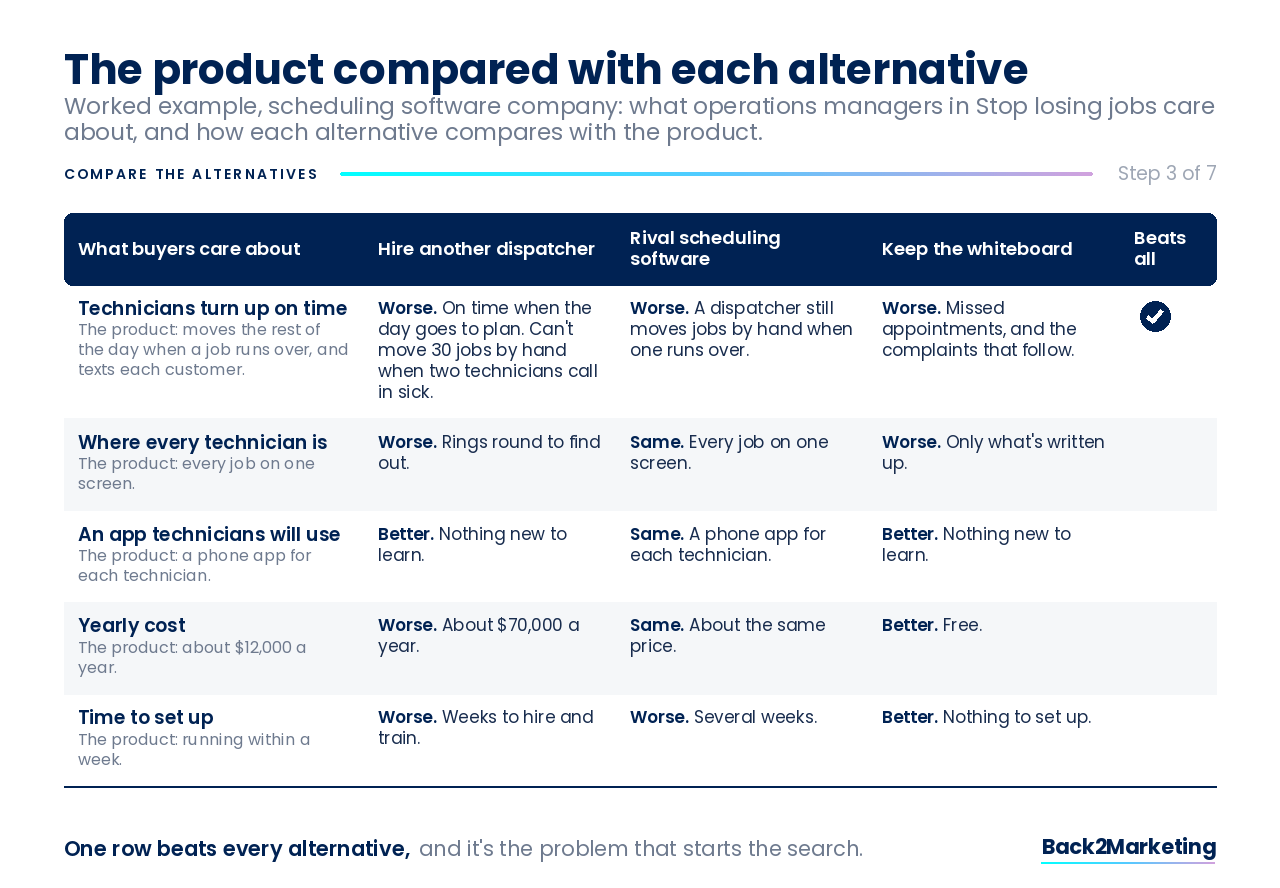
Tick every row where your product beats all the alternatives. On the scheduling company’s worksheet, the row for technicians turning up on time gets a tick.
4. Choose one reason a buyer should choose you
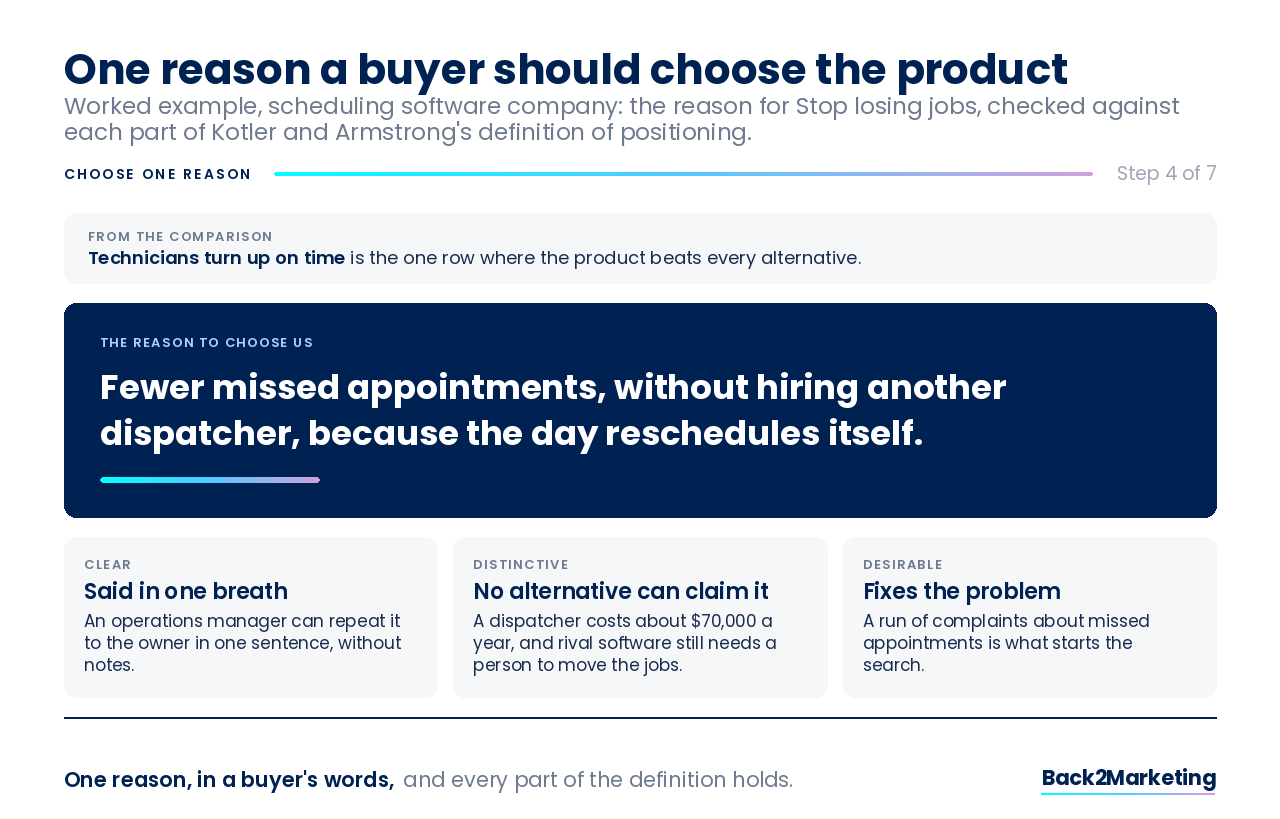
Choose one reason from the ticked rows, even when several rows pass, and write it as a sentence a buyer would say to a colleague. Then test it against each part of Kotler and Armstrong’s definition:
Clear. The operations manager can repeat it to the owner in one sentence, without notes.
Distinctive. None of the alternatives can make the same claim. Check the rival suppliers’ home pages for it too.
Desirable. It fixes the problem that made buyers in the segment start looking.
If any test fails, choose again.
Buyers already deal with a lot of conflicting information. Customers facing conflicting high-quality information are 153 per cent more likely to settle for a smaller, less disruptive course of action than planned, according to a Gartner survey of more than 1,000 B2B customers. Six claims from one supplier add to that pile. A typical B2B buying decision also involves 13 internal stakeholders, according to Forrester’s State of Business Buying 2026, and some of them will only hear about you from a colleague.
The scheduling company writes: Fewer missed appointments, without hiring another dispatcher, because the day reschedules itself. It’s desirable, because a run of complaints is what starts the search. It’s distinctive, because a dispatcher costs about $70,000 a year and rival software still needs a person to move the jobs. And an operations manager can say it to the owner in one breath.
5. Find proof a buyer would accept
A reason without proof is a slogan, so find the evidence before anyone writes a campaign. Proof a B2B buyer accepts includes a customer result with numbers, a reference customer the buyer can call, a demonstration on their own jobs, a free trial and a guarantee.
Ask the customer success team for the results customers in the segment have had. Use the median result across those customers, not your best customer’s result. Ask your legal or compliance team to approve any number before it appears in an ad.
The scheduling company’s customer success team pulls the records for customers in Stop losing jobs who have used the product for at least three months. For the median customer, missed appointments fell from about 6 per cent of jobs to about 2 per cent. Two customers agree to take calls from prospects, and the sales team offers a two-week trial on the buyer’s real job list.
Write the proof on the worksheet, with where it came from and who approved it.
6. Write down what you’re leaving out, and agree the list with the head of sales
Every claim that isn’t the reason comes out of the position, and it moves to the features page, the sales conversation or another segment’s position. Write each claim you’re leaving out, and write where it goes instead. Claims usually come out for one of these reasons:
Every competitor makes them, such as ease of use, security and scalability.
They answer a different segment’s problem.
They describe a feature buyers don’t use to choose, however much the product team cares about it.
The scheduling company moves ease of use, security and scalability to the features page and the security documentation the sales team sends on request. The accounting connection goes into the position for Get paid faster, where it’s the reason. Fast set-up becomes the sales team’s answer when a buyer compares the product with rival software. The words “AI scheduling” come out too, and the marketing team describes what the feature does for the operations manager instead: the day reschedules itself.
Take the list to the head of sales before the campaign starts. Expect some push-back. If salespeople put the dropped claims back into the sales deck, buyers hear six claims again. Agree that the sales team opens with the reason and the proof, and answers the other questions when buyers ask them.
7. Write the position on the campaign brief, and keep it there
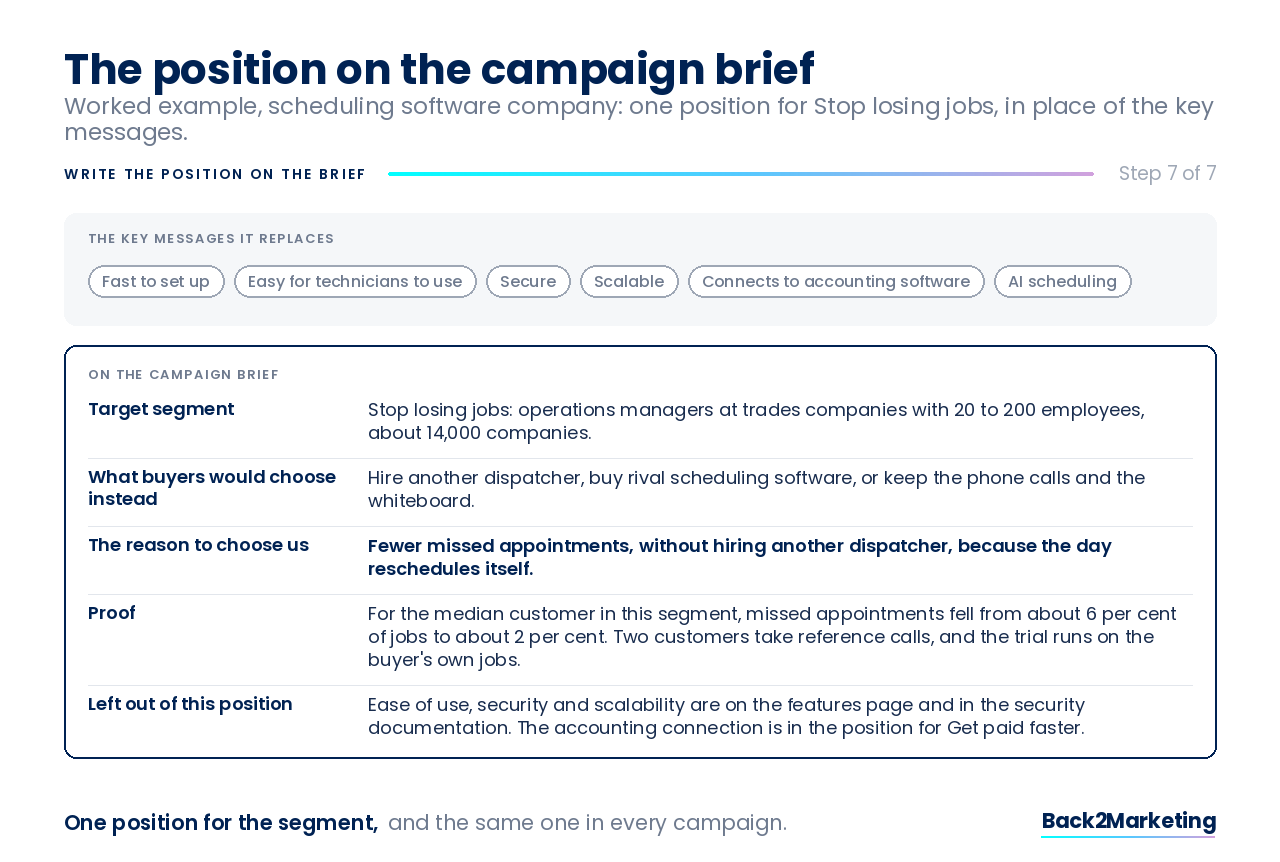
Replace the key messages on the campaign brief with the position, and keep the same position in every campaign for that segment. The scheduling company’s campaign brief now says:
Target segment. Stop losing jobs: operations managers at trades companies with 20 to 200 employees, about 14,000 companies.
What buyers would choose instead. Hire another dispatcher, buy rival scheduling software, or keep the phone calls and the whiteboard.
The reason to choose us. Fewer missed appointments, without hiring another dispatcher, because the day reschedules itself.
Proof. For the median customer in this segment, missed appointments fell from about 6 per cent of jobs to about 2 per cent. Two customers take reference calls, and the trial runs on the buyer’s own jobs.
Left out of this position. Ease of use, security and scalability are on the features page and in the security documentation. The accounting connection is in the position for Get paid faster.
The creative team decides how to say the reason for each audience and format, and the reason itself stays the same. Up to 95 per cent of business buyers aren’t in the market for a category at any one time, according to John Dawes at the Ehrenberg-Bass Institute. Most buyers will meet your position many times before they need it, so keep it until the segment or the product changes.
Ask the business stakeholder to approve the position before you brief the creative team.
Use AI to test the position, and check what it tells you
Give an AI assistant your reason and the home page copy of each rival supplier the sales team named in step 2. Ask it whether each supplier could make the same claim, and to quote the words on their page that come closest. Then ask it to rewrite your reason in the words an operations manager would use, and compare its version with what buyers said in your interviews.
Check your company’s policy before you put customer results or deal records into an AI tool. Don’t ask the AI assistant to choose the reason or write the proof. Choosing the reason is your judgement, approved by the business stakeholder, and the proof has to come from your customers.
Next steps
Choose one target segment, and find out what its buyers would choose instead.
Compare your product with each alternative on what buyers care about.
Choose one reason, and find the proof for it.
Agree with the head of sales what you’re leaving out.
Write the position on the campaign brief, and get it approved.
You can start even if the campaign brief isn’t yours. Copy every claim from your company’s home page into a list, and mark each claim that a competitor’s home page also makes. Show the list to your manager, and ask which unmarked claim fixes the problem your best customers came to you with.
Evidence informs. Judgement decides.
The Positioning Build
The Positioning Build is the one-page worksheet used in this guide. A worked example is printed on it, so you can fill it in without this guide open.

The In Practice guides on market segmentation and targeting [TARGETING GUIDE LINK] show how to choose the segments this guide starts from. The essay on positioning [POSITIONING ESSAY LINK] explains why a list of claims gives buyers no reason to choose you.
New essays land here first: subscribe and the next one will find you.
And if you want to build the judgement, not just the output, Back2Marketing’s B2B Marketing Fundamentals course teaches marketing from first principles.
Sources
Philip Kotler and Gary Armstrong, Principles of Marketing. Definition of positioning: arranging for a product to occupy a clear, distinctive and desirable place, relative to competing products, in the minds of target consumers.
CEB Marketing Leadership Council with Google and Motista, From Promotion to Emotion, 2013. About 3,000 B2B purchasers, 36 brands. Only 14 per cent of business decision makers saw a real difference between suppliers and valued it enough to pay for it.
Gartner, press release, July 2019. More than 1,000 B2B customers. Customers facing conflicting high-quality information are 153 per cent more likely to settle for a course of action smaller and less disruptive than planned.
Forrester, The State of Business Buying, 2026, January 2026. A typical B2B buying decision includes 13 internal stakeholders and nine external influencers, more for larger purchases.
John Dawes, Ehrenberg-Bass Institute for Marketing Science with the LinkedIn B2B Institute, Advertising Effectiveness and the 95-5 Rule: Most B2B Buyers are Not in the Market Right Now, May 2021. Up to 95 per cent of business buyers are not in the market for a given product or service at any one time. Treat the ratio as a rule of thumb.