


The request usually arrives already answered. We need a social strategy. We should be doing more video. We need an AI content engine. Put more into paid search. Someone has picked the tactic, and marketing is being asked to build a case for it.
Nine decisions sit in front of every one of those requests. Until they are made, there is no way to tell whether more video is the right answer or an expensive distraction.
Everyone Can Now Build. Few Know How to Market. argued that as execution gets cheaper, the value moves to the decisions upstream of it. These are those decisions, in the order they have to be made, with what each one produces and how to tell whether you have actually made it.
Work through them in order. Each one narrows the next.
1. Diagnose the situation
Before deciding what marketing should do, establish what is happening. Three views.
The market: how large is it, is it growing or contracting, where is growth coming from, what are competitors doing, what has changed structurally in the last two years.
The business: where revenue comes from today by product, segment and region, which parts are growing, where margins are strongest, where performance is deteriorating.
The customer: what they value, how they buy, what they consider instead, what stops them buying, and what they currently think of you.
What it produces: one page naming the single most important problem or opportunity marketing needs to address, with the evidence for it.
How to tell you have done it: you can state the problem in one sentence, and point to the data behind it. A pile of research with no conclusion is not a diagnosis.
2. Segment the market
Split the market into groups of customers who behave differently enough to need a different response from you.
Choose the basis deliberately. Demographics and firmographics are convenient rather than useful. Needs, buying situation, category involvement, attitudes, occasions and value to the business usually explain more about why people buy.
In B2B, company size, industry and geography are how the database is organised. That is account classification, not segmentation.
What it produces: three to six named segments, each with its size, its growth rate, its value to the business and what makes its buying behaviour different.
How to tell you have done it: the segments change a decision. If your segmentation does not alter who you target, what you offer, how you position or where you invest, it is a description of the market and nothing more.
3. Choose where you will compete
Targeting is the point at which strategy requires sacrifice. Some segments are growing fast and fiercely contested. Others are profitable but small. Some look attractive until you check whether the company can actually serve them.
Score each segment on three things: how attractive it is commercially, how winnable it is given your capabilities and brand, and how well it fits the objective the business has set.
You can target more than one segment. You still have to rank them, because a budget spread evenly across every possible audience is usually too thin to work anywhere.
What it produces: a ranked list of segments with a share of investment against each, and a written list of who you are choosing not to pursue this year.
How to tell you have done it: the list of what you are not doing exists, and someone senior has agreed to it.
4. Decide your position
Positioning is the place you want to occupy in the customer’s mind relative to the alternatives they could choose, including doing nothing.
Write it for the segments you ranked in step 3. What should make you relevant and distinctive to them, and why should they pick you over the other options in front of them.
Then check it is credible. The product has to support the position, and so do the price, the customer experience and the route to market. Communications can reinforce a position. They cannot hold one up while the rest of the business contradicts it.
What it produces: a positioning statement per priority segment, plus the proof points that make each one believable.
How to tell you have done it: you can name what a competitor would have to stop doing for the position to be theirs instead of yours.
5. Set the marketing objectives
Business objectives and marketing objectives are not the same thing. “Grow revenue by 15 per cent” is a business objective. Marketing’s job is to say what has to change in the market for that growth to become possible.
That might be brand awareness, consideration, penetration, trial, retention, price perception, or demand in one specific segment. It comes from the diagnosis in step 1: if awareness is already 90 per cent, raising awareness is not the useful goal.
What it produces: three to five objectives, each with a measure, a starting number, a target and a date.
How to tell you have done it: each objective traces back to a line in the diagnosis, and you can say which business objective it serves.
6. Check the product supports the strategy
Product is part of marketing, even where marketing does not own it.
Does the product solve the need the research identified? Does it deliver the value the positioning promises? Are there features customers do not value, or something important missing? Does the portfolio make sense to a buyer, or only to the organisation that built it?
Sometimes the most valuable marketing decision is a change to the offer rather than a new campaign. Promotion will not carry a product the market does not want.
What it produces: a short list of product changes the strategy depends on, with an owner for each and a date by which the answer is needed.
How to tell you have done it: the product owner has seen the list and either committed to it or told you it is not happening, so you can plan around the answer.
7. Check the price supports the strategy
Price sets demand, signals value, reinforces or undermines the positioning, and decides the economics of acquiring a customer.
A premium position with bargain pricing creates one problem. A mass-market proposition priced at a premium creates another. The right price reflects customer value, competitive alternatives, willingness to pay and the commercial objective, rather than cost plus a margin or the highest number finance thinks the market will accept.
This is also where the unit economics get checked. Revenue growth that destroys margin is not good growth, and a customer who costs more to acquire than they will ever return is not a marketing win because a dashboard counted the conversion.
What it produces: a written view on whether current pricing supports or undermines the position, and the cost to acquire and serve a customer in each priority segment.
How to tell you have done it: you know the payback period on a new customer in your top segment.
8. Build the communications strategy
Only now do the channel questions become answerable, because you know who you need to reach, what they currently think, what you want them to think instead and what has to change.
Decide in this order: the message, the creative idea that makes it memorable, how much reach and how often over what period, the split between brand building and activation, and only then the channels.
Binet and Field’s analysis of the IPA Effectiveness Databank found that campaigns weighted too far toward short-term activation underperform over time, with roughly a 60:40 split of brand to activation as the long-run balance in the cases they studied. Their later work with business marketers put the B2B balance nearer an even split.
This is also where AI belongs, on research, analysis, ideation, production, personalisation and optimisation. It makes execution faster. It does not make a decision you have not taken.
What it produces: a communications plan with a message, a reach and frequency target per segment, a brand and activation split, and a channel list that follows from all three.
How to tell you have done it: you can explain why each channel is on the list by pointing at a segment and an objective.
9. Make sure customers can actually buy
Distribution gets the least attention and loses the most revenue. In B2B that means direct sales, partners, resellers, marketplaces, self-service, account teams, or some combination.
The route has to match the targeting and the position. A high-touch enterprise proposition and a low-cost self-service offer need different routes, and a premium brand may deliberately restrict availability because being everywhere would undermine the position.
What it produces: the route to market for each priority segment, and a list of the places a customer currently cannot buy from you but should be able to.
How to tell you have done it: you have asked a customer to describe how they bought, rather than assuming you know.
Use the sequence backwards when a plan is not working
When communications are generating attention and sales are not moving, do not start with the media plan. Go back up the list.
Can customers buy easily? Is the price right? Does the product deliver what the positioning promises? Is the position relevant to the people you targeted? Did you target the right segments? Was the diagnosis correct?
The first question you cannot answer is where the plan actually broke. It is almost never the last thing you changed.
The same applies to the tactical request. Before answering “should we be doing more video”, ask which objective it serves, which segment it reaches, what has to change for them, and what the diagnosis said. If those answers are not there, the conversation about video is premature.
Next steps
Write the one-page diagnosis, with the market, business and customer views and a single named problem
Draw up three to six segments and check that each one would change a decision
Rank the segments, allocate a share of investment to each, and write down who you are not pursuing
Write a positioning statement per priority segment with its proof points
Set three to five marketing objectives, each with a measure, a starting number, a target and a date
Take the product and price questions to whoever owns them and get an answer you can plan around
Build the communications plan last, message first and channels last
Map the route to market for each priority segment
Only then is the tactical conversation worth having.
Evidence informs. Judgement decides.
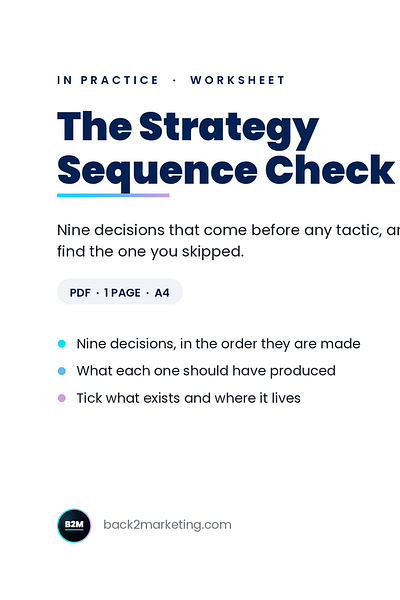
The Strategy Sequence Check
A one-page diagnostic listing all nine decisions, what each one should have produced, and a column to tick whether it exists in writing and where it lives. The first decision you cannot tick is where your strategy stops and your assumptions start. Useful before a planning cycle, and useful when an existing plan is not working.
If you want to work through the whole sequence properly, the B2B Marketing Fundamentals course covers it end to end and finishes with your own One-Page Growth Strategy.
Sources
Theodore Levitt, Marketing Myopia, Harvard Business Review, 1960. Businesses defined by the products they make rather than the customer needs they serve become vulnerable when the market moves. Primary source
Philip Kotler, Marketing Management. The planning sequence used here: research and analysis, then segmentation, targeting and positioning, then the marketing mix, then implementation and control.
Les Binet and Peter Field, The Long and the Short of It: Balancing Short and Long-Term Marketing Strategies, IPA, 2013. Analysis of the IPA Effectiveness Databank. Campaigns weighted too far toward short-term activation underperform over time; roughly 60:40 brand to activation as the long-run balance in the cases studied. Their later work with business marketers indicates a B2B balance nearer an even split, and the authors describe that figure as tentative. Primary source